Kate McDonald on the Paris Olympics, Commonwealth Bars Gold, and the Road to LA 2028 | Ep. 10
Kate McDonald is one of Australia's best uneven bars specialists, a Paris 2024 Olympian and a Commonwealth Games champion. But she wasn't always the bars queen. In this episode of The Gymnastics…

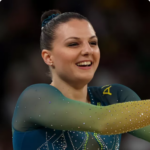
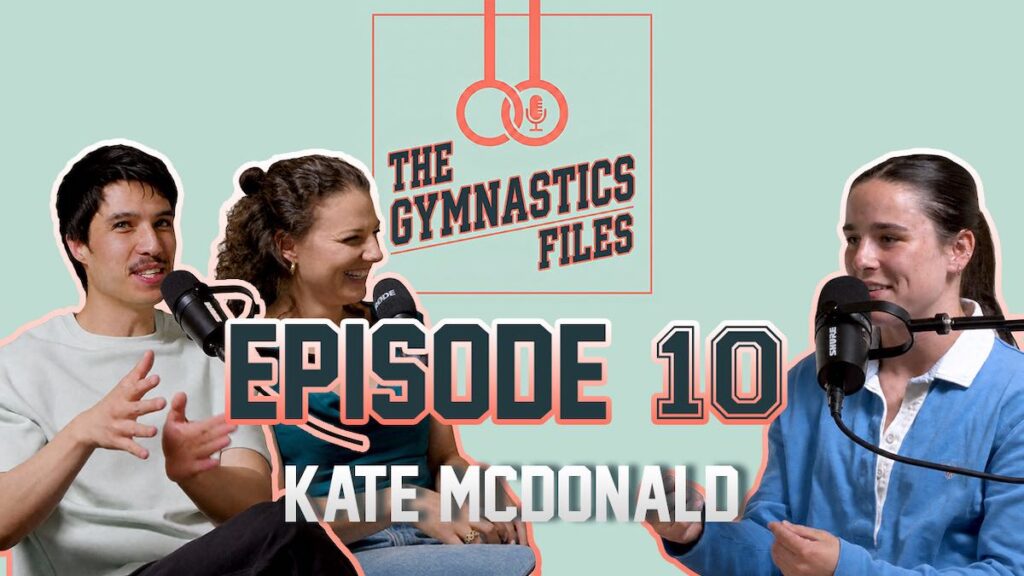
Kate McDonald is one of Australia’s best uneven bars specialists, a Paris 2024 Olympian and a Commonwealth Games champion. But she wasn’t always the bars queen. In this episode of The Gymnastics Files, Kate talks about the late-bloomer years, what really went wrong for her at the Paris Olympics, the mental blocks she’s still working through, and the brand-new skill she hopes will carry her name at LA 2028.
From late bloomer to bars specialist
Kate started gymnastics at five, mostly because her mum needed an outlet for her energy. She stayed in the international program for most of her junior years, but by her own admission she was near the bottom of the group. Bars was her weakest event. It took her years to understand the swing, and she seriously considered quitting.
What changed was time on the apparatus. A run of lower-leg injuries meant she could train bars when she couldn’t do much else, and those extra hours slowly built the consistency she’d been missing. She made her senior international debut in 2017 and has represented Australia consistently ever since.
One constant through it all has been her coach, Jeb, who has coached her for almost 20 years across MLC, Waverley and CYC in Melbourne. Kate credits him with seeing her potential long before she did. Her story is a good reminder that in modern gymnastics, where athletes are competing well into their late 20s and 30s, peaking at 16 isn’t the only path.
Two Commonwealth Games, two very different golds
At the 2022 Commonwealth Games, Kate was selected for bars, but nerves got the better of her in that final. Instead, she won gold on balance beam with a routine she simply trusted from training. Months later at the 2022 World Championships, she posted a huge bars score that announced her as a genuine bars contender.
By the 2026 Commonwealth Games, bars was firmly her event. She came for the team title, helped Australia win it, and finally claimed the individual bars gold she’d wanted since 2022. Teammate Breanna Scott took beam gold at the same Games. That came after a 2025 World Championships where she finished fifth on bars, one of the strongest results on the event by an Australian gymnast.
What really happened at the Paris 2024 Olympics
In 2023, Kate was part of the Australian team that qualified a full team to the Olympics for the first time since London 2012. Paris should have been the dream. Instead, she says it was one of the hardest experiences of her career.
The day before the team flew out, she was told her personal coach would no longer be traveling or coaching on the competition floor. She describes the team environment as divided and the communication between coaches as poor. Kate is clear that the coaches who were there did a good job, but losing the person who had guided her for almost two decades, with no time to adjust, had a big impact.
Then came floor, the team’s first rotation. The beam timer in the arena sounded almost identical to the cue before her floor music, so she started her routine with no music playing. Frazzled, she reset, presented again, and fell on her first tumbling pass.
How elite gymnasts reset after a mistake
With three events still to go, Kate had to move on fast. Her tools were simple: headphones, a competition playlist (think AC/DC, Red Hot Chili Peppers, Fisher, Dom Dolla and Hilltop Hoods), and a focus on supporting her teammates. She stayed on the bar for a solid score and got through beam.
The lesson stuck. When the same timer mix-up happened again at a competition in Turkey, she used her reset cues and delivered a strong routine. For young gymnasts, the takeaway is to work out which cues bring you back to the task, and to practice them before you need them.
The Weiler kip and mental blocks on bars
At the 2026 World Championships in Rotterdam, bars didn’t go to plan. Kate says she arrived burnt out after the Commonwealth Games campaign, and an early miss on her kip cast threw her routine off. It’s a familiar battle: the Weiler kip took her two or three years to learn, and as a junior it even cost her a spot in a bars lineup.
Kate also talks openly about mental blocks. They began on vault in her late teens, when she got the “twisties” on a Yurchenko double, then spread to bars and floor. Working with a sports psychologist, this time on her own terms, has helped her manage them. She has also learned a perfectionist habit to watch for: wanting to restart a routine after an early mistake instead of fighting through it.
The road to LA 2028 and “the McDonald”
The Paris experience didn’t end Kate’s career. It made her hungrier. Her next big goal is helping Australia qualify a team for the LA 2028 Olympics, with an individual route through the World Cups on bars as a backup. Next year’s World Championships will be the big qualifier, something we unpacked in our 2026 Worlds preview.
On bars, she’s working on connecting her clear hip full to her Tkachev for extra difficulty and cleaner execution. She’s also training a laid-out Tkachev from a swing, a skill no one has competed before. If she lands it at a major competition, it would be named after her.
On floor, every tumble now lands forwards. Kate has very limited ankle range, so landing backward strains her back. In 2021 and 2022, she rebuilt her routine around forward-landing skills.
Life outside the gym: three jobs, coeliac disease and Cirque du Soleil
Like many elite athletes in Australia, Kate funds her career by working. She coaches gymnastics at two clubs and works as a surf coach at URBNSURF, alongside 20-plus hours of training and twice-weekly strength and conditioning at the Victorian Institute of Sport. She also completed an environmental science degree at Deakin University.
She was diagnosed with coeliac disease in 2022 and talks about fuelling a high-volume training week without gluten (two breakfasts are standard). After gymnastics, she plans to try Cirque du Soleil before moving into marine biology.
Watch the video below
ON LIFE AFTER THE PARIS OLYMPICSI still loved the sport. I just didn’t enjoy the politics.
Key Topics
About the guest
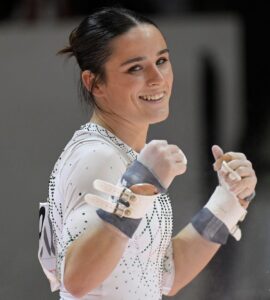
Kate McDonald
Kate McDonald is a Paris 2024 Olympian and one of Australia’s leading uneven bars specialists. Based in Melbourne, she trains at CYC under Jeb, who has coached her for almost 20 years. She won beam gold at the 2022 Commonwealth Games, finished fifth on bars at the 2025 World Championships, and at the 2026 Commonwealth Games won team gold and the bars title. Off the competition floor, she holds an environmental science degree from Deakin University and coaches gymnastics and surfing.
Transcript (click to expand):
Read the full transcript
Arman Liew: Today we have a very special guest who has just gotten back from Rotterdam via Portugal: Kate McDonald. Welcome to the podcast.
Kate McDonald: Thanks for having me. I feel like there should be applause in the editing.
Arman Liew: We’ll put some applause in. You got back on the weekend and, as we caught up on before, you’re back training already.
Kate McDonald: Yeah, straight back into it. I’ve got some big goals for next year, so I’m keen to get on the ground and start running.
Arman Liew: Perfect. We’re definitely going to get into those goals. You’re not a stranger to the gymnastics community because of your many successes, but let’s take it back to what we were talking about before, around 2018. Was that when you became a senior?
Kate McDonald: I was two years into senior, so I was 18 in 2018. But I think 2018 was my first international competition, so I was pretty fresh onto the scene. I was a bit of a late bloomer.
Emma Nedov: I remember our first comp together. Actually, it must have been 2017: Flanders International. I just remember Kate popping out, and it was like, “Oh, where have you been?” What’s so interesting about your lead-up to senior international is that it wasn’t the same as most of us who’d been through the system. Did you start training a bit later, or get into the elite levels later?
Kate McDonald: No, I was just a bit rubbish.
Emma Nedov: And there it is.
Kate McDonald: I started gym when I was five, and I can’t remember exactly when I went into the international program, but I was there pretty much the whole time. I was very much a late bloomer, though. It took me a really long time to get my requirements on bars.
Arman Liew: On bars?
Kate McDonald: I was really bad at bars when I was younger, and it was probably one of the reasons I thought about quitting. But I stuck with it and very, very slowly progressed from there. Now we’re here, so it’s paid off.
Emma Nedov: It has paid off. You’re 26 now, you’re back in the gym, you’re working upgrades, LA 2028.
Kate McDonald: Hopefully, hopefully.
Arman Liew: That’s so fascinating to hear, that you weren’t great at bars growing up. I think everyone listening is going to have their jaw on the floor: “Wait, Kate McDonald wasn’t a bars queen from a young age?” What would you have called your strongest apparatus back then?
Kate McDonald: Maybe floor, potentially.
Arman Liew: Not vault?
Kate McDonald: I was okay at vault a couple of years back, but not when I was younger.
Emma Nedov: What do you think contributed to bars not being your best? The reason we’re hovering around this is that now, I’d say you’re most well known for your bars.
Kate McDonald: Oh, 100%. I think Jeb, my coach, always saw the potential in me. I’ve had him for almost 20 years, maybe 17 or 18. I’d do some great things every now and then, but everything in between was not good. I just couldn’t understand the swing. It took me so many years to do a basic swing half. Some days things worked and other days they didn’t. I was really inconsistent, but I’ve finally found that consistency. I was also injured a lot when I was younger, a lot of lower leg injuries, so after those injuries I had to train a lot more bars. Eventually, putting in more hours, I got a lot better, and it became a specialty after that.
Arman Liew: So good. You just needed extra time.
Emma Nedov: Which is great for people to hear. With the longevity that’s now happening in gymnastics, you don’t have to feel so rushed. At least when I was under 16, there was a real rush. You felt like you had to do a lot in a very small amount of time, like you were peaking at 16 years old. And now we’re peaking well past our use-by date.
Arman Liew: You touch on a really good point there, because that use-by date has really moved on. You can look at countries like Brazil, where I think a lot of them are in their late 20s. I think Ellie Black’s in her 30s, right? The age is just being pushed back.
Arman Liew: If we skip forward to 2022, I don’t think much happened in the gymnastics world during the COVID era besides the quiet Olympics. I think that’s when a lot of the non-gymnastics public really got to know you, at the Commonwealth Games. Was that your first major competition after the COVID blackout?
Kate McDonald: Yeah. I went to 2019 Worlds, and the next major competition was Comm Games. During the COVID era I really knuckled down on my training. There wasn’t much else to do, and I’d graduated from school, so training was a priority. I just kept at it, slow and steady, and really started to consolidate all my skills and get that consistency.
Arman Liew: And you’re a Melbourne girl, so we did not have a great lockdown, did we?
Kate McDonald: No, we did not.
Arman Liew: How did you train? Did you train at home, or borrow equipment? I’ve been curious about how you keep your skills up.
Kate McDonald: I was really surprised coming back into the gym. I didn’t lose much fitness at all. We did a lot of training at home, still two sessions a day. We borrowed equipment and bought equipment, like an AirTrack. I already had monkey bars and a tramp at home, so that was all right. We did heaps of strength, and had panel mats and boxes for basic skills. I started going for runs, which was the dumbest thing of my life. I hated it.
Emma Nedov: It’s like that with all gymnasts.
Kate McDonald: None of us like to run. Not a runner at all. But coming back into the gym after COVID, I felt quite fit. I think that was the first time I realised you can actually have time away from the gym, a lot of time, and still come back to where you were. I actually got better very quickly because I was so strong. Since then we’ve started doing strength and conditioning at the VIS. I’d completely forgotten about that time. It was such a long time ago.
Arman Liew: So at Comm Games, you won beam. Was that expected? I think bars was what you were planning on first.
Kate McDonald: I was on that team for bars. I had good potential on bars and qualified for the final, but I was very new to the international scene and making finals. I think I was just a bit inexperienced. I got inside my head thinking, “I’m on the team for bars, I could get a medal in this,” rather than focusing on the actual skills and the process to get a good routine, and then a medal for Australia. So I pushed that performance aside. My beam routine was really consistent. I didn’t fall much. We did downgrade the wolf turn because I was having issues with it, but apart from that the routine was so solid. I just trusted my training, and the routine came out how it did in training, which was really nice. I was very shocked to get the gold, especially against some incredible athletes. They just didn’t have their best day, and I had a really good day, so it made up for the bar mishap.
Arman Liew: It’s so funny, because then you went to Worlds and everyone who’d seen you at Comm Games thought, “Okay, here’s the beam queen coming to Worlds,” and then you did an insane bar routine. I still remember it because it was such a huge score, and people were asking, “Where did this girl pull that from?” That’s when you really started to make a name for yourself on that apparatus.
Arman Liew: Then 2023 was an important Worlds, because you were trying to qualify a team for the Olympics. How was that experience compared to Comm Games and Worlds the year before?
Kate McDonald: I feel like every international competition is stressful. You want to do well for your teammates and for the country. But looking back on 2019, we’d missed out by a whisker. It was an awful feeling, so we certainly didn’t want to repeat that. It was incredibly stressful, but a really fun comp to be part of, especially qualifying the team to the Olympics, since we hadn’t had one since 2012 or something. The team worked really cohesively, and I thought that was really special. It didn’t all go to plan; there were a few mishaps. But we all stuck together and supported each other through the whole process.
Arman Liew: I always wonder what happens once you’ve finished and there are still a few subdivisions to go. Are you watching the other competitors, watching the scores, or going outside to forget about it and checking back later?
Kate McDonald: We had the afternoon off. Georgia went to the comp because she was in a position to make the all-around final, which she did. The rest of the team sat in someone’s room watching the live stream and doing all the calculations. There’s a video of us. We put someone’s phone somewhere to record our reactions, because we were in a good position to make the top 12. When the final score came in, we all got so excited. It was a really fun moment to have with everyone.
Emma Nedov: What a contrast to 2019. From my perspective, I want to know: did you always want to go to the Olympics? Was that the reason you did gymnastics?
Kate McDonald: At the start, Mum just put me in gym because I was a menace at home and had a lot of energy. Slowly the hours picked up, and apparently I was okay at it, but I was still at the bottom of the food chain, really. As a young kid you look up to the older girls and their dreams of going to the Olympics, and you see them at Comm Games, World Championships, Olympics. You always want to be like them, and that was definitely me. In my teenage years it was a dream, but I didn’t think it was really possible. But I stuck with it, and Jeb was incredibly supportive. Having him by my side helped me get to that position. Then slowly I realised I was in a really good position to make the team, and helping qualify the team for the Olympics was massive. It was a dream come true.
Arman Liew: Going back to working with Jeb for so many years: were you always at the same gym? When we were talking earlier we found out we grew up in the same area, and I wondered whether you’d always done such a long commute.
Kate McDonald: I started at MLC.
Arman Liew: Oh yes, nice.
Kate McDonald: Jeb was there. Then he moved back to Adelaide, and the international program shut down not long after. All the MLC girls moved to Waverley. He then came to Waverley, and when he left Waverley, I moved to CYC with him.
Emma Nedov: What years was that? What’s so fascinating is that you had your international debut in 2017, and from there, COVID aside, you’ve very consistently represented Australia. When did you go to Waverley, have time without Jeb, and then move to CYC?
Kate McDonald: I’m pretty sure 2012 was when we moved to Waverley. I think he moved to Adelaide at the start of 2012, we all moved to Waverley at the end of 2012, and he came to Waverley in 2013. So there was about a year where I didn’t have him. Then I moved to CYC at the end of 2021, or around then. I can’t really remember. I think that’s the timeline, but I could be wrong.
Arman Liew: Oh wow, so you were at Waverley for a while. That’s a long timeline. When we were talking at the start, I thought, wow, that’s commitment from a young age to go all the way there, so MLC makes sense.
Arman Liew: Let’s talk about the Olympics. You had a team, which is great, and some other people came back for it. How was your Olympic experience? Was it what you thought it would be?
Kate McDonald: It wasn’t. I didn’t have the best time. A lot of things happened. The coaching situation wasn’t ideal. I was thrown under the bus the day before we left, which wasn’t great. It was an awful experience. Emma was there for that; she remembers. The village was really cool, though. Waking up surrounded by the best athletes in the world, all the swimmers and everyone, was incredible.
Kate McDonald: The comp didn’t go to plan. We were on floor first, and I fell on my first tumble. There was a bit of a music stuff-up, and I didn’t know how to deal with it. On beam and floor, you have a minute 30 to do your routine, and with 10 seconds left on beam, a timer goes off. It sounded exactly like the ding before my floor routine. I was ready for my floor routine, the beam timer went off, and because I was nervous I thought it was my cue. I started my routine, there was no music, and I was like, “What the hell is going on?” Then my music played a second later, and I’d missed the timing. I was really frazzled. I need cues to reset myself, and I didn’t know that at the time. So I presented, walked off, presented to the judges again, walked on, did my floor routine, and fell on the first tumbling pass. Worst feeling of my life. I felt like I let the team down. I was devastated. I had the potential to do a really good floor routine and put up a really good score for the team, and it didn’t happen. I’m still so upset by it.
Kate McDonald: The same thing actually happened in Turkey earlier this year, and I was like, “Are you kidding me?” But I’d learned from the Olympics. I reset, did my cues, and then did a great routine. Jeb was like, “How does this happen once, let alone twice?”
Arman Liew: It needs to be a whole different sound, like a chicken noise.
Emma Nedov: The FIG needs to change the beam ding.
Kate McDonald: They do. It used to be a bell, but it’s not anymore. At least I learned from that experience. But it wasn’t a great experience for me. I didn’t do as well as I should have.
Arman Liew: Do you think the coaching issues and team issues affected that?
Kate McDonald: 100%. I think if we’d had different coaches, it would have been a very different experience. Or not even different coaches: if the situation hadn’t unfolded the way it did, it would have been very different.
Arman Liew: You still did a good competition, but maybe, in your perception, not the best it could have been.
Kate McDonald: I felt like it was pretty divided. I don’t know about Emma, but I felt there wasn’t very good communication between the coaches. That could have been a lot better. Could it have contributed to a better result? Maybe, maybe not.
Emma Nedov: It’s very clear from your experience as a gymnast that you’ve had Jeb as your coach from the start. You’ve had a very consistent coach, and not everyone has that.
Kate McDonald: No, not at all.
Emma Nedov: And your coach was also a guiding light, saying, “You can go to the Olympics, you can do this,” and believing in you at times when you perhaps didn’t quite believe in yourself. So it’s no surprise that not having that presence there would make such an impact on anyone.
Arman Liew: Absolutely. Did anyone communicate with you personally about the changes that were going to happen, or were you surprised?
Kate McDonald: It was communicated the day before we left that he wasn’t going to be on the floor and wasn’t going to travel with us.
Emma Nedov: I think it’s the non-travel part, because you’re away for quite some time, and there’s no time to adjust.
Kate McDonald: I was fine working with the coaches we had there. They were great, technically and everything. But he was meant to be traveling with us. I was told the day before we left that he wasn’t coming anymore, that he’d made the decision not to come because of something that happened. I was told this was on purpose, and I think it ultimately ruined the team.
Emma Nedov: It’s important for you to be able to speak about that. From my perspective, there’s no more difficult feeling than feeling like you’ve not only let yourself down but let others down. So I can definitely say: don’t worry, I’ve never thought that. We all feel the same way. Your coach has played such a huge role in your career and in your belief in yourself from such a young age. Having one coach for the majority of your career is quite unique. That’s not common.
Arman Liew: And if you bring the human side to it, that’s really difficult. You were training with the expectation that he’d be there, and then that bomb was dropped the day before. That would affect anyone. If you’d known a month or two before, you could have adjusted your training.
Kate McDonald: 100%. I could have trained with the coaches who were there. Everyone did a really great job of supporting me and supporting Jeb, but it was an awful situation for everyone to be in.
Emma Nedov: So, going back to that competition. I actually don’t know how you felt after floor, because I was thinking about me.
Kate McDonald: As you do.
Emma Nedov: That’s what you do when you’re competing. You have to focus on what you’re doing. But for people listening, whatever age or level you’re at, you’re going to make mistakes and have to keep going. It was the first apparatus. How on earth did you pull yourself back together?
Kate McDonald: I didn’t. Well, I’d figured out that music really helps me. I took a minute to feel terrible, but I had the whole team, and I didn’t want to let them down. I already had—
Emma Nedov: You hadn’t.
Kate McDonald: —but I didn’t want to let them down more. So I told myself I needed to get in my zone. I put my headphones on, because that always helps me. I listened to music, pumped myself up, tried to support everyone on vault, and then got in my zone for bars, because I knew I could help the team a lot there and potentially get a really good score. I didn’t do the bar routine I wanted, but it is what it is. I stayed on the bar and put up a 13-something, I think, which is better than a fall. Same for beam: headphones on, support everyone as well as I could, get back in the zone and pretend the floor thing didn’t happen. Then after the comp I had a fat cry.
Emma Nedov: We all had a fat cry.
Arman Liew: That’s a testament to you, because after the first apparatus, how do you get yourself out of that headspace? Thank you for sharing that. Let’s touch on the headphones. There are multiple photos of you in the media with headphones on. The most important question: what are you listening to?
Kate McDonald: I always get that question. It’s a mixed bag. I have a comp playlist. I’m a pretty superstitious person, but I just try to put on songs that pump me up: a bit of AC/DC, a bit of Red Hot Chili Peppers, Fisher, Dom Dolla, all the good Aussie DJs, and Hilltop Hoods as well, a bit of rap. So it’s not one single song; it’s a whole playlist. Normally after my routines, good or bad, I forget which song I was listening to.
Emma Nedov: You’re also on the music at camp. When we were getting ready, you were on the music. The song that reminds me of you from the Olympics is “Talamanca.”
Kate McDonald: Yes! Whenever I listen to that song, I think of the Olympics and getting ready. I love that song as a result. I love music.
Arman Liew: After Paris, what was your mindset with gym? We know you continued, but was there a point where you asked yourself whether it was worth it?
Kate McDonald: Straight after Paris, I was like, “Well, I’m done.” But I still loved the sport. I just didn’t enjoy the politics. I was done with the politics and all the drama around my coach. I loved training and I loved being coached by Jeb. He’s an incredible coach and an incredible person. I was keen to get back in the gym to train, but not to compete, because I was over it all. I took a bit of time away. We went to Mallorca and London with the girls, which was really nice. When I went back into the gym, I didn’t really know what was happening. It was a bit of a lull in my training, which I feel happens a lot with athletes after the Olympics. But I was keen to get back out there because I wanted to redeem myself, and I knew I had more to give. The Olympics was a big goal of mine, but Commonwealth Games was so much fun in 2022, and I thought I’d love to finish on a high at another one. So a couple of months later I decided to give it another red-hot crack for a couple more years, maybe improve at Worlds and make a team final or an apparatus final. I was hungry to give more to the sport, and I wanted to do it with Jeb.
Arman Liew: You have to tell us the secret in that recipe, because you came back in 2025 at the World Championships and really cemented yourself as one of the best bar workers in the world. I’ve seen people on Instagram with a ruler working out whether your Tkachev is two metres high.
Emma Nedov: Arman always comes out with these fun facts from Reddit.
Arman Liew: People are literally trying to work out the height. I think someone said you could fit three gymnasts under it. But it was such a great comp for you. Did you do anything differently in the lead-up, or at the competition? You had your coach there, as a starting point.
Kate McDonald: I had my coach, yeah. And there was a lot less pressure at that Worlds because it was individual. I love competing with the team, but because it was individual, I thought, it doesn’t matter if I do badly. I also started working with a sports psych, and I think that helped a lot. I was reluctant to do that when I was younger. It was forced on me and it didn’t go well, so this time it was on my own accord, and that worked a lot better. I worked on techniques to calm the nerves and all that jazz. It was just a really fun comp. I tried to have as much fun as possible with Ruby and Bree, we all had our coaches there, and it all fell into place. I didn’t really do anything different. I just kept working on myself and my gymnastics, and I added an upgrade, the clear hip full, which upped my difficulty.
Arman Liew: And I think your result is the best bars result for an Australian, right? That’s huge.
Emma Nedov: Bars queen. Love it.
Arman Liew: It’s so good to put that side by side with you saying you were really bad at bars as a kid. That gave you a great headspace coming into 2026 and the Commonwealth Games, which was your redemption in some ways.
Kate McDonald: Look, I had beam. It would have been great to get a medal on beam again, but that was Bree’s medal. I was like, “Bree, this is your medal.” The first one was by accident. I came for the team medal. The team gold was kind of unspoken, but I think we all knew we were capable of it. We just had to have a good comp. And I was so hungry for that bars medal, to redeem myself from the previous Commonwealth Games. So I’m very happy.
Arman Liew: So the takeaway is that in the beam final, you purposely didn’t do your best routine so Bree would get it, because it was yours for the taking.
Kate McDonald: Do you know what? Bree’s untouchable on beam. I wouldn’t say I purposely did that. It just wasn’t a great routine. I wobbled on everything and missed all my connections.
Arman Liew: But on bars, it was a tough field with lots of great bar workers, and you came away with the gold. You touched on the unspoken goal of the team gold, which we talked about with Bree as well: none of you said out loud that you wanted it, in case saying it meant it wouldn’t happen. You started on bars, which is a great apparatus to start on when it goes well. Was there any point in the competition, maybe after floor, where you thought, “The gold is ours”? Or was it still a case of waiting?
Kate McDonald: At 2023 Worlds, we had a great start to the comp. Bars was great, beam was great, floor was great. Then we went to vault, and Emily fell and Ruby stacked it. It was very high pressure for Bree and Georgia after that. At Comm Games we’d done the same rotation order as 2023 Worlds. Kat King, the physio who was there, said, “You’re done now, how are you feeling?” I said I was really nervous. She asked why, and I said I couldn’t tell her right then, because I think everyone was thinking about 2023 Worlds, how we’d had such a great start and then it all came apart on vault. So I certainly didn’t think it was over until the last person on vault had landed. We were all very stressed about that. Afterwards we were like, “We’ve broken the curse, we’re fine.” I think at 2023 Worlds we all learned that it’s not over until it’s over.
Arman Liew: I think Bree was saying that as well, that she’s very nervous about vault. Comm Games was a very successful competition for you guys. And then the most recent one was Worlds in Rotterdam.
Emma Nedov: I shouldn’t laugh. It’s only because just before, we were talking about the dreaded bar skill. Before we get to this year’s Worlds, we were talking about 2017 and 2018, and how you struggled with your bars development. Do you think some of that reappeared?
Kate McDonald: 100%.
Emma Nedov: So talk us through what happened, and maybe your reflections.
Kate McDonald: I got up on bars, and Jeb had said all the right things. It wasn’t his fault, absolutely not. This was all my fault. It’s all a bit of a blur. I think I was a bit burnt out going into Worlds. I didn’t have the best prep. I’d done routines, but not enough. I just wasn’t in the right mindset, and I couldn’t snap out of it. I was grateful to be there, obviously, but I wasn’t with it at all. So I get to bars and think, “All right, let’s go, I’ve got a good bar routine, I can help the team out.” Then the kip cast didn’t go over. In Turkey earlier in the year I did the same thing, and then fell about three more times in that bar routine. I scored about an eight.
Emma Nedov: I don’t remember that.
Arman Liew: Wait, an eight in execution?
Kate McDonald: No, all together. I can normally get an eight in execution.
Emma Nedov: Is there a video of this somewhere? We’re going to go find it.
Kate McDonald: It’s an issue I’m working through at the moment. If I fall on my first skill, or a skill at the start like the Weiler kip, I just want to start again. I have this mental issue where I can’t finish the routine because it has to be perfect, and that’s absolutely not the right mindset to go into a bar routine with. That happened in Turkey, and I learned not to lose it and to keep going. So in Rotterdam I was just telling myself, “Don’t do what you did in Turkey, just muscle your way through the routine.” It went by in a blur. I just wanted to get through it, and I wasn’t thinking about my cues after the stop. It was a bit disappointing.
Emma Nedov: The reason I brought up the previous years is that the Weiler has been an issue in the past.
Kate McDonald: Oh yeah. It took me two or three years to get that skill, and I’m still trying to master it. I couldn’t get a reverse requirement in my routine for so long. I had the catch, the pak, the shap, the shap half, the toe full, the dismount, everything but this reverse requirement, and it was impossible to get. I tried reverse giants, I tried so many things, and nothing worked. It took me so long to get this bloody Weiler kip, and I think it will forever haunt me.
Emma Nedov: It’s so interesting that you’ve done the skill for so long, but old habits really die hard. It’s insane. Can we bring up how, almost as punishment, in 2017 in Belgium you had to do vault?
Kate McDonald: I was on a trip with Emma to Flanders International in Belgium. This was back when I still did vault, but I was really scared of vault and hated it. I had some balking issues. I’d been working a Yurchenko double, but then I got the twisties, and I had to relearn how to do a Yurchenko because I was so scared of it. I ended up being able to do a full, but from six steps. Literally six steps down the vault run. Mihai was the head coach at the time, and he was deciding who would do which apparatus. Bars was what I was best at, and he refused to put me in the bars lineup because I didn’t have the reverse requirement, my Weiler kip. So as punishment, he put me up on vault with my dodgy little Yurchenko full from six steps. I dreaded it so much. Looking back, it’s so funny.
Emma Nedov: You poor thing. I just remember thinking, “Oh man, you poor thing.” But I’m going to say something pretty crazy: you’ve got a gold and a fifth on bars, so let’s bring back the Yurchenko double.
Arman Liew: I think you should.
Emma Nedov: Bars is gone now. Sorry, Jeb. He’s going to watch this and never speak to me again.
Arman Liew: We said it here first: Kate McDonald is becoming an all-arounder at the next major competition. What a silly thing to do, though, punishing you by not putting you on your best apparatus.
Emma Nedov: I don’t think it was actually punishment.
Kate McDonald: It was 100% punishment, because he was so angry. He wanted me to do a reverse giant, and I was like, “Mihai, I can’t do a reverse giant. I literally can’t hold on to this bar with my tiny little hands.” Reverse giants are so hard. Jeb had constructed the routine to have the Weiler kip or some reverse skill at the start, and the reverse giant made no sense there and was ugly as hell. When I tried training it, it was awful. Jeb’s routine construction made sense with the Weiler at the start; it just wasn’t ready yet, and it wasn’t ready for a long time. But he stuck by it, while Mihai was adamant that I put a reverse in before it was ready.
Emma Nedov: Kudos to you, though, seriously. You’ve gone from not thinking you could do bars and not having a natural swing to this. Was there an element of fear as well?
Kate McDonald: Oh, 100%.
Emma Nedov: Did you experience mental blocks?
Kate McDonald: Not when I was younger. I was always at the bottom of the group, the one being strung along, like the little Shetland pony that’s kept around to keep everyone else calm. They’re really cute. The fear kicked in during my late teens, when I was doing Yurchenko doubles and got the twisties. That’s when the mental blocks started, I’m pretty sure. It started on vault and then came into bars and floor. They still occur, but I’ve been working with a sports psych and communicating with Jeb, and everything’s pretty good now. It still happens every now and then, but it really affected me later on.
Emma Nedov: You were probably pretty disappointed at this Worlds. I imagine you’re now able to move past it and not let it make you nervous for next year. You’ll keep the Weiler in?
Kate McDonald: 100%. The Weiler’s staying in. I was disappointed. I’ve processed it, though I probably still should process it a bit more. But I’m absolutely not letting those performances on bars and floor define me. There are a lot of reasons it didn’t go to plan, and if anything, it makes me more hungry. I learn the most from a bad performance, and it makes me really hungry to do better and prove myself. I find it trickier to back myself up after a good competition. At the last Worlds I came fifth, and I think I put a lot of pressure on myself to do really well on bars this time. I was thinking about that in the back of my mind rather than the process involved in getting the routine I need. And on top of that, how many months was it between Comm Games and Worlds? Not many. I worked really hard before Comm Games, and then I needed a break, because it was such a big campaign and we won.
Emma Nedov: That’s the other thing. I don’t think the comedown from that adrenaline is discussed a lot.
Kate McDonald: 100%. I think we were all burnt out, and I especially was. Getting back into the gym was a bit of a slog, and I was a bit of a slug.
Arman Liew: You’re allowed to be a slug when you win so much at Commonwealth Games. And you also graduated uni.
Kate McDonald: I did, two years ago, in 2024, after the Olympics.
Emma Nedov: I don’t think there’s a timeline on burnout, to use the word we all use, but you’ve achieved not only your gymnastics success but also university. That’s no walk in the park.
Kate McDonald: I feel like it was a pretty easy degree. Environmental science.
Arman Liew: At Deakin?
Kate McDonald: Deakin. It’s pretty easy, but it puts me on the right pathway for the future, when I retire from gymnastics.
Arman Liew: Staying on this year’s Worlds: was there much pressure within the Australian team to do really well? After the success at Commonwealth Games, there was a lot of talk in the media about whether this team would make team finals, plus individual accolades. And coming off a bars final the year before, so many people were posting their predictions of who’d make the final, and you were always in those names. Did you feel any of that pressure?
Kate McDonald: I had no idea about the media. I thought the media focus was on the teams that made the finals. But our goal was certainly to make a team final. In our team meetings, that was 100% the goal. There was a lot of pressure, considering we’d done really well at Comm Games and put up a really good score, with still a lot of room for improvement from that score. I didn’t notice it in the media, but we put a lot of pressure on ourselves, and I certainly put a lot of pressure on myself. And it unfolded a little bit. A lot of it.
Emma Nedov: You said that you didn’t discuss winning gold at Commonwealth Games; it was just something each of you knew internally. And at this Worlds it was discussed, and I remember in 2024 it was discussed too. Do you think maybe, moving forward, not talking about it is better?
Kate McDonald: It might be the best option. I think it’s good to have goals within the team and have them clearly outlined, so everyone’s on the same page. But considering our success when we didn’t discuss it, that would be quite helpful. I use that process a lot myself: I need to execute my routine well to get a good score, and focusing on that always helps me produce a good routine. So I think that would be a good idea.
Emma Nedov: There’s a difference between goals and expectations. It would almost be better to say our goal is for everyone to perform their best, rather than for us to be top eight.
Kate McDonald: Yeah, and both of those points were discussed. We always talk about how, in order to do our best, we’ve got to have fun. So it was a bit of both. But I think discussing what we need from each other and what we can do might be better than focusing on the end result.
Arman Liew: You still made the top 12 with two falls.
Kate McDonald: I’ll take it. That’s something.
Arman Liew: That’s still really positive. And a lot of other teams didn’t make the team final when they expected to, like Great Britain. That was a big surprise.
Arman Liew: Coming into next year, the deciding year for the Olympics, are you changing anything or going in with a different mindset? Had this been the Olympic qualifying year, we’d have a team for Australia.
Kate McDonald: We would have.
Arman Liew: Who knows what will happen next year? We were talking with Bree about her routine construction and how she’s working some upgrades to peak in 2027. Are you doing the same, or knuckling down on your current routines?
Kate McDonald: A bit of both. I think bars will stay the same, with the Weiler. We’ll see how we go, though. I want to play around.
Emma Nedov: The Yurchenko double?
Kate McDonald: I wish. I can’t land backwards anymore. But on bars, I’d love to have a new skill. I’ve been working a laid-out Tkachev. I’ve done it about four times and never caught it.
Arman Liew: People have been saying, “Kate’s Tkachev is so high, why doesn’t she do a layout?”
Kate McDonald: I’ve been trying. It’s very, very difficult, and no one’s done it before from a swing. So that’s a goal of mine.
Arman Liew: Oh my god, amazing. The McDonald!
Kate McDonald: I’d love the skill to be named after me. I don’t think it’ll be ready for 2027, but maybe going into 2028.
Arman Liew: LA. Best time to debut the McDonald.
Kate McDonald: We’ll have a play with that. But my main goal for bars is making the routine nice and consistent and connecting the clear hip full to the Tkachev. That gives me an extra 0.1 in difficulty, and it would also reduce my execution deductions, because when you connect things, the judges take less.
Arman Liew: That’s why Kaylia Nemour just connects everything. She never stops.
Kate McDonald: On beam, I’m looking to upgrade my wolf turn, just small things. Same with floor: upgrading my turns but keeping the tumbles the same, and maximising those landings. I think I can help the team with a really solid floor routine. Same with beam: focusing on getting my execution to eight and above on all three apparatus. So it’s mostly staying the same, with small upgrades.
Arman Liew: It’s funny that you say you can’t land backwards, because it makes sense: your tumbles on floor all land forwards. Is that a fear thing?
Kate McDonald: No, that changed in 2022. My ankle range is really bad. It’s essentially non-existent. In 2019 at Worlds, when I was doing floor routines (I obviously wasn’t in the floor lineup, because I couldn’t land), I would land my double pike with straight legs and use my back, because I couldn’t bend my ankles. I was pulling my back quite a lot. So we decided to change to forward landings and have a play with forward tumbling. Around 2021 or 2022 I started working a handspring double front, a handspring double twist, and then a two and a half landing forwards, and slowly got more consistent. Now everything I do lands forwards.
Arman Liew: Had you injured yourself, and that’s why your range isn’t as good?
Kate McDonald: No, I’ve just had limited ankle range since day dot.
Arman Liew: Way to adapt. Absolutely work with what works for you.
Kate McDonald: Not for the Yurchenko double, though. But a Yurchenko two and a half? Half an Amanar.
Emma Nedov: An Amanar, let’s go. Manifest that, and the McDonald for LA.
Arman Liew: We’ve absolutely got to manifest that. I hope we see it. Something we talk about with a lot of our guests is funding, which is an issue in many sports. As you get older your needs change, and many people are working to balance everything. Have you been able to get funding to help with training? Or do you need to work, or compete in competitions with prize money, if that’s still common?
Kate McDonald: I currently have three jobs. I’m a gymnastics coach at CYC, and I’m a gymnastics coach at a club closer to me called Eastern, in Box Hill, so I can keep training and work separate. I love CYC. It’s a great club and they’ve been very supportive of me, so I coach for them once a week straight after training, because CYC is so far from home. I love giving back a little bit. I do the majority of my hours at Eastern. And a year or two ago I got a job at URBNSURF, so I’m also a surf coach.
Arman Liew: URBNSURF, near the airport?
Kate McDonald: Tullamarine. It’s also far away, but—
Arman Liew: We should go.
Emma Nedov: Could you coach us? Oh my god, that’d be hilarious.
Arman Liew: It’s so funny. When I did gymnastics, I started at Box Hill, which has become Eastern now. They merged many, many years ago.
Emma Nedov: That is so cool.
Arman Liew: But wow, three jobs. How often are you at URBNSURF?
Kate McDonald: That one’s casual as well. I’ve got five shifts coming up in the next two weeks. I’m normally rostered on once or twice a week. I normally put in Wednesdays and Fridays, straight after the VIS, since it’s only half an hour away. I’ve also put down Saturdays, after morning training, so I can spend the whole day there.
Arman Liew: And how many hours a week are you training?
Kate McDonald: That’s a good question. It depends how quickly I get my program done. It used to be around 30, but now I think it’s in the 20s, so it’s really dropped off. I’ve been doing strength and conditioning twice a week at the VIS since 2022, I think, so I’m doing fewer gymnastics hours and more strength and conditioning. It’s a good balance.
Emma Nedov: As you get older, your gymnastics skills almost require your body to be stronger.
Kate McDonald: 100%.
Emma Nedov: That’s a lot of energy to be using, though.
Kate McDonald: When I’m not doing gymnastics, I’m coaching or in the water, and it is hard. Right before competitions I get really fatigued from doing all the routines, so I have to drop my hours, especially at URBNSURF. I’ll block it out to once a week instead of two or three times. It’s very physical, but I love it. I love being outdoors and in the water. It’s so much fun.
Emma Nedov: Is your goal still marine biology one day?
Kate McDonald: Yeah. Post-gym, I’m actually wanting to go into circus: Cirque du Soleil. Jeb has a lot of contacts. I thought I’d go a little bit insane going from 20 or 30 hours of gymnastics a week to nothing, so Cirque du Soleil sounds all right. I still love flipping around, and my body’s in good shape at the moment. I’d love to do circus, travel the world and get paid for it. So I want to do that for a couple of years and then go into marine biology.
Emma Nedov: I’m impressed. Your passion for movement and for gymnastics is so clear throughout your whole career. You’ve spoken about so many things that would derail someone and make them throw in the towel. Have you ever thought about it? Do you have a motivation to stay in, or do you simply love it?
Kate McDonald: I really do love it. There have been so many times I’ve wanted to throw in the towel, for sure, absolutely after a bad comp. But after a bad comp I also know there’s more I can give, so I feel hungry to keep going. It comes down to enjoying it so much and having who I think is the best coach in the world. I have heaps of fun in the gym. Despite being past my use-by date, I still feel like I have heaps more to give.
Emma Nedov: Ellie Black’s going to watch this and be like, “What the hell?”
Kate McDonald: Not for many more years, though. I’m kind of ready to move on, but I still have a lot of goals. I still want to make a team final at Worlds, I still want to make an uneven bars final, and I want a skill named after me. There are still little goals that I think are very achievable.
Arman Liew: And the Olympics? Is making a final there a goal?
Kate McDonald: 100%. The first step is to qualify. I want to qualify a whole team again. I want to redeem myself, redeem our performance, and see where we can go with it, without saying out loud what our goals are. Making some finals would be icing on the cake. But the first step is 100% qualifying that team.
Arman Liew: And the next Worlds is in China.
Emma Nedov: Without being a total downer, do you have a way you’d qualify yourself if there wasn’t a team? Just as a worst case.
Arman Liew: It’s a fair question.
Kate McDonald: 100%. We haven’t really spoken about it, but I assume through the World Cups. I wouldn’t be vying for the continental position, because I don’t do all-around anymore. I don’t do vault.
Arman Liew: You never know. Maybe the Yurchenko two and a half comes back, because you’d need that Oceania spot.
Emma Nedov: I have full faith in your ability to do that, by the way.
Arman Liew: We’d be such a great vaulting nation: the two and a half, plus Bree’s Shaker double pike.
Kate McDonald: But no, we don’t do vault anymore. That’s long gone. Through the World Cups on bars, 100%. I think that would be my best option. Or through Worlds, making a bars final.
Arman Liew: Let’s manifest not having to rely on that. Should we wrap up with some rapid-fire questions? We always ask our guests what they eat in a day, because people find it so fascinating to see what an athlete needs to fuel themselves. It’s very different to Emma’s time, when it wasn’t very much.
Emma Nedov: To be fair, Kate had a few years of that.
Kate McDonald: Maybe, because I went to camps. But I didn’t care. I just ate whatever the hell I wanted. I was hungry, man. I need fuel.
Arman Liew: Stuff some gluten-free bread in your bag.
Emma Nedov: Speaking of which, you do so much. It’s not just gymnastics, which already requires a lot of fuel. Now you’re surf coaching, gym coaching, on your feet all the time. What on earth do you eat in a day?
Kate McDonald: So many things. I normally have two breakfasts, two lunches, two dinners. I eat so much food. I love a good stir-fry. I try to meal prep as much as I can, though it’s hard. I’ll have Weet-Bix with some fruit in the morning, then go home and have eggs with avocado and all that jazz. Before training I’ll have a salad or a sandwich, depending on what I feel like. I just love carbs: pasta and all that.
Arman Liew: So good to hear that a gymnast just loves carbs.
Kate McDonald: I love my carbs. But I was diagnosed with coeliac disease a couple of years ago, so carbs are less fun now.
Arman Liew: So quite recently?
Kate McDonald: It was 2022, I think. I got really sick in Paris because I ate a bread roll I thought was gluten-free and it was not. So then I ate another one, because I was going to get sick anyway, so I may as well enjoy the good bread.
Emma Nedov: Oh, there were so many allergy issues.
Arman Liew: How did you find out you were coeliac? Did you just eat some white flour one day and realise it wasn’t working for you?
Kate McDonald: It slowly accumulated. I’d have pasta or bread with every meal, and occasionally I’d randomly get sick, and I didn’t think much of it. One time I ate doughnuts and got sick, and I told Macy and Romi I got gastro from doughnuts, and they said, “No, you didn’t, that’s not possible.” That was me having a reaction to gluten, but I didn’t realise. Then in January 2022 I got really sick for about a week. I went to the doctor thinking I had stomach ulcers from taking too many Voltaren anti-inflammatories. She did a blood test and asked if I was coeliac. I said no; my grandma was, but Mum had been tested a million times and she wasn’t. Then I got the results, and it was a very, very high reading. It switched on just like that. It turns out it can switch on after a bit of trauma, and that was pretty much straight after I left Waverley.
Arman Liew: Wow. So your whole life without being coeliac, and then in 2022, it switched. Okay, note for us: don’t get stressed.
Emma Nedov: Well, then we shouldn’t be doing anything that we’re doing.
Arman Liew: Luckily there’s lots of good gluten-free stuff being made now.
Kate McDonald: There is now. It’s pretty good.
Arman Liew: Ten years ago, you might have struggled. Back to gymnastics: with the current crop of Australian athletes, are there any juniors you think are standouts that we as a country, and as a world, need to keep an eye on?
Kate McDonald: I haven’t been around the juniors a lot, so I don’t really know. Even at training camps with the juniors, I’m in my own bubble, doing my own thing. But I think we have a good group of juniors: Maddie Fazio, a girl from Geelong called Olivia, and all the girls currently at the Youth Olympics, Zara and Alice as well. They’re a really good group of girls.
Emma Nedov: And Megs, who you trained with?
Kate McDonald: Oh, Megs, 100%. She’s 19, I think, and she’s coming through. She came through the national level program and she’s looking really strong. I think we’re getting a bit of depth back, which is nice. But again, I’m in my own little bubble.
Emma Nedov: Whether you know it or not, Kate, you have inspired so many people.
Kate McDonald: Oh, thank you.
Emma Nedov: Your journey has very much not been linear. You’ve overcome hurdles that a lot of people deal with, and that people speak about more now than ever before. Your ability to bounce back, your hunger to prove yourself, doing it at an older age, finishing uni and having interests outside gymnastics while still having a passion for it: that’s really inspiring for a lot of people.
Arman Liew: It really is. The last question: are you going to Japan?
Kate McDonald: Yes, I am. Originally I wasn’t. We’ve got a training camp in December with the Japanese national team.
Arman Liew: With the Japanese team? Great team.
Kate McDonald: I don’t know why I said no in the beginning. It’s been a big year financially. A lot of money has gone into my trips, and I spent a lot in Portugal.
Arman Liew: Your holiday? Well deserved.
Kate McDonald: So I wasn’t sure I’d be able to afford it, and the girls didn’t seem too keen. Then all of a sudden Tara, the head coach, came to our gym and said that Georgia and I were the only two who’d said no. And I was like, “Well, I’m there.” I had a bit of FOMO. This Japan trip is once in a lifetime and 100% worth the money. I’m not going to be doing gym forever. Why would I say no to that opportunity when gymnastics is only such a short period of my life? Why would I not just say yes to everything?
Emma Nedov: Sorry, do you have to pay for the whole thing?
Kate McDonald: Not the whole thing. It’s partially funded, but we still have to pay a bit.
Arman Liew: Have you been to Japan before?
Kate McDonald: I have not, so I’m really excited.
Arman Liew: It’s a great country. I’m trying to convince Emma that, with some of the business stuff we do with photo shoots, we can go back.
Emma Nedov: Maybe we can go and interview the Japanese team. Can we piggyback?
Arman Liew: We’re going to be in China anyway. How long are you going for?
Kate McDonald: I think either a week or 10 days.
Emma Nedov: That’s an awesome opportunity. Kudos to whatever they’re doing, because getting to go over and train with the Japanese national team is amazing. They’ve improved so much in the past three or four cycles.
Kate McDonald: They’re insane. It was incredible being in the same subdivision as them this year and just watching their training. It’s absolutely insane what they do. It kind of reminds me of the Mihai times, but they seem to be happy. They’re enjoying themselves.
Emma Nedov: Are they doing warm-ups in tracksuits?
Kate McDonald: No, they’re not doing warm-ups in tracksuits, so not quite like the Mihai times. But the intensity of training, 100%. Doing floor routines in the podium training gym before doing a floor routine in the competition arena is just insane.
Emma Nedov: There’s something to be said for that. We might laugh about how hard that time was, but we were machines. Little well-oiled machines. Well, I wish I’d been a bit more well-oiled than I was. But that level of intensity does take you places.
Kate McDonald: Absolutely. I feel like that’s part of the reason I’m still competing today. I went through that, and yes, it was really hard, but it taught me what hard work is.
Arman Liew: So good. I feel like there are a million other questions we could ask you, and now I just want to talk about Japan, which means we’ll have to have you back on to hear how the trip went. Thank you so much for coming on. Knowing how busy you are on top of gym, we’re really grateful you made the time to come this way. I’ll probably bump into you when I visit Mum and take her for a walk down Greythorn Road; we might meet halfway. And I should probably go back to Eastern and see if they remember the gymnast who came last. We’re really grateful you gave us more insight into the famous Kate McDonald, and we’ll be keeping our eyes out for multiple things now: an Amanar on vault, and a laid-out Tkachev.
Emma Nedov: The McDonald.
Arman Liew: Let’s go to Maccas! Thank you for coming on, and thanks for watching or listening to another episode of The Gymnastics Files. We’ll see you next week.
Emma Nedov: Thanks, Kate.
Kate McDonald: Thanks for having me.