
Fireside Files – Emma and Arman Chat + a 2026 Worlds Preview | Ep. 5
In Episode 5 of Fireside Files, we catch up on life and preview the 2026 World Gymnastics Championships. Wedding planning should be simple until you are staring at a venue contract, choosing…

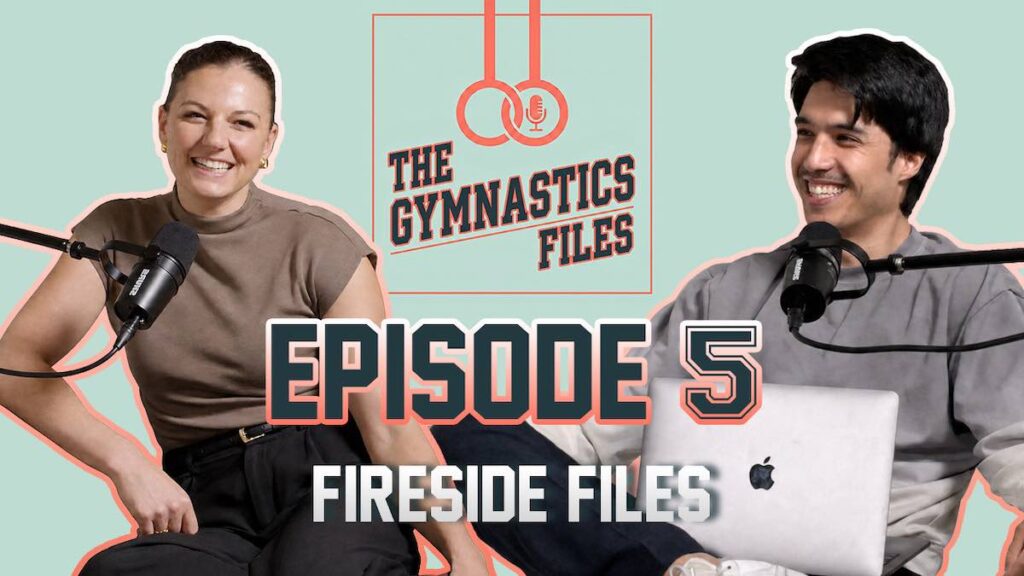
In Episode 5 of Fireside Files, we catch up on life and preview the 2026 World Gymnastics Championships.
Wedding planning should be simple until you are staring at a venue contract, choosing flowers in ten minutes, and realizing your guest list is basically a gymnastics reunion. We kick off this Fireside Files chat with real-life updates, the funniest wedding logistics, and how our sport sneaks into everything, from who travels internationally to the very real possibility of backflips on the dance floor.
Then we zoom out to the bigger picture of life after elite gymnastics. We talk about why in-person connection matters more than a highlights reel, how High Tea With Emma became a mentorship space for young gymnasts and parents, and what it looks like to keep the gymnastics community close while building a career beyond competition.
From there, we shift into a World Championships preview that is equal parts curiosity and strategy. We unpack MAG and WAG storylines, Olympic qualification pressure, team chemistry, lineup decisions, and the names we are watching across Australia and the international field. Expect talk about artistry deductions, injury comebacks, rising seniors, and why this Worlds feels wide open compared to the usual predictions.
Watch the video below
ON THE 2018 WORLD GYMNASTICS CHAMPIONSHIPSIt was the worst experience of my entire career. It was the one where we trained like, up to 20 days in a row.
Key Topics
Transcript (click to expand):
Read the full transcript
Arman Liew: Hey guys, welcome to another episode of The Gymnastics Files. Today’s one is something we’re going to do at least once a month, maybe more depending on time, and we’re calling it Fireside Files. It’s going to be life, things that are happening, and Q&As, because we’ve been getting a lot of questions and a lot of feedback from people already, which has been really, really exciting. We’ll also delve into a little bit of Worlds, which I think we’re both going to be quite elementary on, because it feels like a whole new crop of athletes. So it’ll be exciting to see how this progresses. But let’s bring it back to something not even gymnastics related. How’s everything going with you? You’ve got a wedding coming up in, is it six weeks? Seven weeks?
Emma Nedov: Six and a half. What are we? Oh, today’s Friday.
Arman Liew: So six weeks. And how’s all the planning going?
Emma Nedov: I got my bouquets done yesterday in a matter of, like, ten minutes. I’m ticking things off one by one. As you know, planning is a whole thing.
Arman Liew: Yeah. People can hyper-focus on certain aspects of it, like wanting a particular flower. But when you’re busy, it’s just: flowers, done, and you did it in ten minutes.
Emma Nedov: Did you know what flowers you wanted?
Arman Liew: No, not particularly. I think we had a colour theme. And actually, we were really lucky, because a friend of ours had just set up a wedding planning business a few months before our wedding. She was based in the UK, and we’d invited her as a guest, and she sent a message saying, “Oh, look, I’m starting a wedding planning business. I know you guys have probably done everything already, but would you be keen for me to do some of the management on the day?” It was really, really handy, because when we did the planning, our only priorities were enough food for everyone and enough alcohol for everyone. We didn’t really care too much about the other details. So she came, gave us some ideas, and I think we pretty much sent her to the Queen Victoria Market on the day of the wedding to pick up flowers to put on every table. It worked out really well, and it was really well priced, because as soon as you say “wedding” to a florist, the price doubles. We did have a flower wall that was quite nice, but it was probably one-hundredth of the size of [inaudible], just a stand. The florals were nice, but not a big part of it. So you’ve got your bouquet sorted, and if you need something else on the day, just go to Vic Market, get some flowers and put them out.
Emma Nedov: Yeah. The partner who organises all of my High Tea with Emma events has just taken it upon herself, because she’s sick of the fact that I have no idea what I want.
Arman Liew: Which is great.
Emma Nedov: I know what I want, but it’s in my head, so articulating it is really difficult. And then you ask Julian, and Julian’s like, “Oh, I don’t really care.”
Arman Liew: That makes it easy. You make the final decision, until maybe he sees the flowers and is like, “What is this?”
Emma Nedov: Yeah. Although when we got the contract for the venue, I was just like, “Yeah, yeah, whatever, I’m sure it’s fine.” I went to sign, and Julian’s like, “Stop, we need to read the final details.” And I was like, “Oh my god.” So anyway, he’s organising the alcohol, because for us the priorities are alcohol and the dance floor.
Arman Liew: Oh, no food?
Emma Nedov: Everyone can starve. It comes from my gymnastics background.
Arman Liew: Actually, this is so unrelated to gymnastics, but a friend of a friend didn’t serve dinner at her wedding. In the invitation, she said, “You’re welcome to order Uber Eats or whatever you want for yourself.” I think she had a cheese platter of sorts, but that was it, and I was so baffled. I don’t know if I’d even want to attend a wedding where there’s nothing like that.
Emma Nedov: Wait, what do you mean? So everyone’s getting Uber Eats to the venue?
Arman Liew: I think it was the reception. They had the ceremony in a church in the morning, and then at night it was somewhere in the Docklands, with a basic cheese platter or something like that. But it literally said on the invite, “You’re welcome to order Uber Eats or whatever you like for some food.” People were just eating pizza and tacos and stuff.
Emma Nedov: Okay, no, we’re not that bad. We’re doing canapés at the start, entrée, mains, and cake for dessert. So we are eating. The priority is just that everyone has drinks and then dances it off. And then at the after-party, we’ll get burgers and fries and stuff like that.
Arman Liew: Oh, that’s really cool. We did a Macca’s delivery at about 10:30, because you’ve had your dinner at eight, everyone’s been dancing, and you just want something at 10:30. So burgers and fries, great. All sorted. You’ve had such a long gymnastics career. Will there be many special gymnastics faces there?
Emma Nedov: Yeah, all the Olympic girls will come. And Georgia Godwin, and my OG bestie, Georgia-Rose Brown, who’ll be my witness.
Arman Liew: All the way from Singapore.
Emma Nedov: Yes, she’s coming. We have quite a few internationals. Mitchell Morgans will fly from France for the wedding, because he’s training and competing in France at the moment. He actually gets paid to do that.
Arman Liew: He gets paid to do that? Wow, we need to get him in. Who knew? France, of all places. Not that I mean… French gymnastics is elite. The MAG and WAG teams are fantastic. But I had no idea they had their own sort of…
Emma Nedov: It’s a league. I can’t remember what it’s called. Like Bundesliga or something like that.
Arman Liew: Wait, is that the football league? Maybe they’re called the same thing.
Emma Nedov: I don’t know. We’re going to have to look that up.
Arman Liew: Because I do know football has a league like that as well. But maybe it extends to gymnastics, which is great. And Jesse was telling us there’s an Italian league of sorts as well.
Emma Nedov: And German.
Arman Liew: And German. Wow. Just send all our athletes over there to Europe. It’d be great to have a chat to him, actually, about how he got into it, and whether you need some ties to France before you do it.
Emma Nedov: Why don’t we just do a Gymnastics Files back-to-back, and then I’ll walk down the aisle?
Arman Liew: Yeah. Just get Inside Gymnastics magazine to cover it and livestream it. This would be a 7plus Sport spectacular.
Emma Nedov: But yeah, so I would say… well, Julian, my fiancé, did gymnastics until he was 18. Most of our friends are from gymnastics, from when I was 12 years old. One of my bridesmaids, Sarah, is one of the girls I trained with from the ages of 13 to 16. And my other bridesmaid, Erin, and I were at the 2018 World Championships together. There are just gymnastics people scattered throughout our entire wedding. So there’ll be lots of backflips on the dance floor.
Arman Liew: I was going to say, maybe you should put on someone’s floor music and get them to go out and do an off-the-cuff floor routine.
Emma Nedov: God, no.
Arman Liew: Oh, no, that’s exciting, and it’s exciting that it’s so close. Maybe I’ll have to livestream it from The Gymnastics Files account and get everyone involved.
Emma Nedov: Yes. It’s no secret. Well, actually, I’ve had my High Tea with Emma events this year. For those that don’t know, I have young gymnasts come and have high tea with me. They get to ask questions and meet other gymnasts in their state. I’ve held it in five different states across Australia: Melbourne, Sydney, Perth, Adelaide and Brisbane. So I’ve actually got a little community group on WhatsApp with them and their parents. I haven’t done it yet, but I’m going to say that because we’re getting married in a church, anyone can come to the ceremony. So if they want to come, they’re more than welcome.
Arman Liew: So cool. And that’s such a great thing about what you did with High Tea with Emma, which I’m going to keep pestering you to continue next year, because I think it’s such a great concept and something that’s so needed. It’s so nice to have that. And who knows who might turn up?
Emma Nedov: Yeah. I think it’s just an opportunity. When I stopped training, I still stayed in contact with a lot of the girls. And I was up to some really cool stuff, like we get to sit here and do this podcast, and I wished I could keep everyone across what I was getting to do with my gymnastics. A lot of these opportunities, including creating The Gymnastics Files podcast, come from my experiences of being a gymnast. Loads of my friends are from being a gymnast. So I just wanted to keep everyone across what I was doing, if they were interested, and show them, “Hey, this is what you can do.” That’s kind of where High Tea came from, because you don’t really have the same reach through social media, and it’s just not the same vibe. Social media is a bit of a show. It’s a highlight reel. So I thought this was actually a tangible way for people to be along the journey with me. Anyway, we’ll see what unfolds, but that’s where the idea came from, and that’s why I thought, “Oh, cute, they can come to the wedding if they want.” Every little girl wants to get married [inaudible].
Arman Liew: Of course, and they get to come and see a gymnast get married in real life. It is the life after gymnastics.
Emma Nedov: Weddings.
Arman Liew: So yeah, there’s lots of stuff in the works, and I guess the beauty of these chats is that we can just talk about it and get people involved in the other side. There’s more to it than just hearing from every athlete about what they’re doing. And I think you’re proof that there’s so much you can do with your gymnastics career, which leads us into some current events. The Paris World Cup just happened. I think Australia sent a couple of gymnasts, but it was a very international field, and some really impressive scores came out of it, all in the lead-up to Worlds. Countries are slowly announcing their teams, because they have to by a certain date. Otherwise FIG, the Fédération Internationale de Gymnastique, is kind of like, “You can’t bring a team anymore, you’re too late.” I think the Americans just released their WAG team yesterday, maybe. Let’s start with what we’re not super familiar with, which is MAG. The Australian team is similar to the Commonwealth Games team. We had Jesse here, and I think he just announced on his own social media that he isn’t doing floor. I’m trying to think of the other guys in the team. James Hardy’s really good at floor. We’ve got Riddham Malik, who’s also great on floor. And Aidan Frick: I saw some of his stuff at, I think, Nationals, and he’s got some really, really good tumbles. So even though Jesse’s high scoring potential might be missing there, I think the other guys should be able to pull it together and deliver something quite special. And on the other apparatus, as Jesse said, we’ll be keeping an eye on pommel horse to see what happens.
Emma Nedov: Yeah. Well, I think this Worlds is also a test for next year’s Worlds. Next year’s Worlds is obviously going to be the decider for the Olympics. I did get this confirmed: the top three teams from that World Championships make it automatically to the Olympics. So I think our Australian MAG team will want to see how they work as a team, and then what they need to improve on for next year’s Worlds to qualify for the Olympics. Because, you know, Japan, America… I mean, Russia’s going to be there?
Arman Liew: Yeah. And China, of course. China just won the Asian Championships. There’s always been this battle between China and Japan, and at the Asian Championships that just happened, the Chinese MAG team beat Japan by five or six points. We’ll get to WAG a bit later. But five or six points is a huge margin, especially between the top two teams.
Emma Nedov: Wow. Yeah, so the top three right now is naturally very difficult. We’ll have to get that pea shooter out again. So for the boys, this will be a really interesting World Championships to see how the team works, what worked, what didn’t, and what they can do better for next year’s Worlds. But I think we’ll be fine with Jesse not doing floor. It’s a good opportunity for him, because there’s a lot of pressure on him. There’s a lot riding on just him as one athlete, and you never want to put all your eggs in one basket.
Arman Liew: No, and historically, other countries have done that, where they hone in so much on one athlete that it puts so much pressure on them, and they build the forecasting for the whole team around that. You’ve got a really good point. If we just go off scores, you’d think Japan and China are shoo-ins. Who’s been really impressive over the last couple of quads, and this team is a really good example, is Great Britain.
Emma Nedov: Oh, yeah, of course.
Arman Liew: The team that was named had one member from the Commonwealth Games, but he wasn’t from the England team. He was from the Scottish team: Reuben Ward. So it goes to show how much depth there is, that they have such a big pool of athletes to pull from. Then there are some of the guys who were probably competing around the time you did, like Courtney Tulloch, who I think has made the team, and he’s… Chelsea.
Emma Nedov: Yeah. My friend called him Chelsea at the World Cup.
Arman Liew: Which is believable… not believable, but honestly.
Emma Nedov: She’s one of my bridesmaids. Erin.
Arman Liew: She’s one of your bridesmaids! We should call her Edith or something like that.
Emma Nedov: Honestly, when you meet Erin, just say, “Oh, it’s Chelsea.” She’ll understand immediately. Because it wasn’t once that she called Courtney Chelsea. It was multiple times. Anyway, yes, he’s been around for a long time, so he’s a very good competitor. Who else is on the Great Britain team?
Arman Liew: Probably one of my favourite MAG gymnasts, Jake Jarman.
Emma Nedov: Oh, yeah.
Arman Liew: He’s quite short, but he is so powerful. I saw some of his training clips from a couple of years ago, and I could be wrong on the number of twists, but I’m pretty sure he did a quad, four and a half maybe. Four twists, and then he added a layout front at the end of it, and all these other crazy moves. And he’s so good at vault. Then there’s the other guy… what is his name? I can picture his face. I’m going to have a quick look at my notes, because I added a little note on him. Harry Hepworth. He’s very similar: still very strong on floor and vault.
Emma Nedov: Is he newer?
Arman Liew: No, I think he was at the last Olympics, in Paris, and I think he won a medal of sorts on vault or floor. We’ll have to double-check that. He’s really good as well. Based on all the scores we’ve seen, I think it’s going to be a race for bronze between them and the US. The US team is always quite strong in MAG. And the Swiss team: I think they did quite well at Europeans, and they’ve got quite a few people on the team who are really strong.
Emma Nedov: They’ve always had huge potential, actually. Just under the radar a little bit.
Arman Liew: Always in that fourth-to-sixth place, pushing into the top three. I think they had really good results at Europeans. And then if we look back at the Commonwealth Games, Canada had Félix Dolci, who I think is going to do well. He was just on The Traitors, the reality show, in Canada. But maybe they filmed that ages ago.
Emma Nedov: Yeah, probably. But what is that show?
Arman Liew: It’s really popular here and in the US. It’s like the game Mafia: three people are traitors, but you’re in a room, you have to do tasks, and you try to guess who the traitors are. Each episode, I think you vote out someone you think is a traitor. And the traitors have to lie and pretend that they’re faithful.
Emma Nedov: So did he do well?
Arman Liew: I think they’re still airing it. At the start you get told if you’re a faithful or one of the three or four traitors, and I think he was a faithful. I just saw some clips of him trying to convince people to vote someone else out. So yeah, Canada’s always really good. This is our research before next year’s Worlds, before we meet some of these athletes: understanding MAG a little bit more. If we go into apparatus, Carlos Yulo from the Philippines.
Emma Nedov: Yep, brilliant.
Arman Liew: Absolute machine. And his brother is competing as well, and looks exactly like him. Actually, at the Asian Games, Carlos bleached his hair a little bit blond. It looks really cool, but I also don’t know if he did that to differentiate himself from his brother, because they look identical. He’s obviously a gun on vault and floor, so I wouldn’t be surprised if he makes those finals.
Emma Nedov: He reminds me of Chris Remkes.
Arman Liew: Oh, he does, doesn’t he? Who’s also a gun at floor and vault, and is equally as short. That was such a defining factor of seeing the podium with Carlos Yulo on it: the other two guys who medalled were the same height as him. On pommel horse, and I could be botching the name, there’s Hong Yanming, who’s the defending champion. I think all eyes will be on him to retain that. And then from Australia we’ve got True Hagens. It would be so good to see him make the final, because he’s scored in the high 14s on several occasions. I think at the Commonwealth Games trials it was almost a 15, maybe a 14.7 or 14.8. So he’s got the potential.
Emma Nedov: It’s very possible. With True, the only thing that could potentially be a barrier is that it’s World Championships, and there might be a bit of pressure. Pommel is like the men’s version of balance beam: the ones who stay on the apparatus are usually the ones who end up in the top eight.
Arman Liew: Yeah, it isn’t an easy apparatus. You can make a little mistake and ruin your chances. Historically, a lot of countries have had a pommel horse specialist, and it comes down to the day of qualifications. It’ll be really interesting to see True and some of the other teams. The American team is a really good example as well. It’s a very young team, so it’ll be really good to see how they go at this World Championships, where there’s pressure, but not heaps and heaps of pressure like there will be next year. So maybe they’ll have a bit more fun or try out some skills.
Emma Nedov: I hope they go into it from that perspective: “At this one, we can risk more and be open to making mistakes.” Because if they don’t go into this Worlds with that mindset, well, you want to have your stuff together for next year’s Worlds.
Arman Liew: Yeah. And did you have that sort of experience? You did 2018 Worlds, and then 2019 Worlds was the one that decided it. Was it pressure that whole time?
Emma Nedov: 2018 Worlds was the worst experience of my entire career.
Arman Liew: Really?
Emma Nedov: Yeah. It was horrible. I don’t think I thought about the competition once. The competition was just a matter of, “I hope that I do not die.” That was the one where we trained up to 20 routines in a row. But you’re right. Usually this awkward one, two years before the Olympics, is the one where you have a little bit less pressure on you.
Arman Liew: Yes. Unless you’re trying to make the top three, there’s probably a bit less pressure on you. Which, again, I swear is a new rule from last quad and this quad, right?
Emma Nedov: It is new. It hasn’t always been that way. In 2014, I went to the World Championships. It was my first one, and it was this time of year, two years before the 2016 Olympics. At the 2014 World Championships, Lauren Mitchell did her ankles in training. Everyone was saying on all these blogs that the Australian team was totally screwed now because they didn’t have Lauren. If we didn’t qualify in the top 15, or it might have been the top 16, at the 2014 World Championships, we weren’t even eligible to try to qualify for the Olympics in 2015. So people were saying we weren’t even going to come top 15 in 2014. Which, might I say, became seventh.
Arman Liew: I was about to say, didn’t you make team finals?
Emma Nedov: We made team finals. That was one of our best World Championships results to date.
Arman Liew: Wow.
Emma Nedov: So we kind of had different metrics. I don’t know if they still had the top three automatically qualifying. They might have, but I do know you had to hit the top 15.
Arman Liew: Yes, and that’s still a thing. If you’re one of those border countries in, let’s say, 10th to 16th place, you still need to do well at this Worlds to qualify for next year’s Worlds. Otherwise you get pipped, and you might only be able to send a couple of individuals. So there’s still a bit of pressure there. If you go in with the mindset of, “We can have a lot of fun, and we can all fall,” that might not be the best mindset. But it’s good to go and do your full routine on a stage at the top level.
Emma Nedov: Yeah. The only difference right now, I think, is that in 2016 we had Olympic test events. That’s what Australia did. We got our seventh-place team result at the 2014 World Championships, and then at the 2015 World Championships I think we came… I actually don’t fully remember. I want to say 14th. So we were sort of at the bottom. I think you had to qualify top 12 at 2015 Worlds to make the 2016 Olympics, and if you were in 12th to 16th place, you went to the Olympic test event for the remaining spots. There was a set number of teams. However, there’s no such thing as an Olympic test event anymore. That’s where I was going with that. Now it’s a bit more defined: you either qualify at World Championships or World Cups. That probably makes sense, because the 2016 Olympic test event was in April or May 2016, in Rio.
Arman Liew: In the host country?
Emma Nedov: Yeah. We were competing at the Olympic stadium two or three months before the Olympics. And I don’t know if you remember, but for Olympians, the village and all of that was just a nightmare. Nothing was set up and nothing was ready. So it might have made things even more difficult to prepare.
Arman Liew: Yeah. And I’m pretty sure at the test event, the top two teams would get the final two Olympic places.
Emma Nedov: Yeah, I think it was. And we came third or something.
Arman Liew: I feel like that was worse than a World Championships, because you have to hit there.
Emma Nedov: It was so scary. Such a scary competition. Spain beat us.
Arman Liew: Spain beat you guys for it? Wow.
Emma Nedov: Yeah. Anyway, sorry, I’ve just redirected us.
Arman Liew: No, that’s really interesting to hear about.
Emma Nedov: So WAG and MAG always have the same qualification processes. But I think our Australian MAG team is definitely in a good place to make the top 15, surely.
Arman Liew: Yes, they showed us at the Commonwealth Games what they can do, and as Jesse said, that was with errors. So who knows what’s going to happen? And they’re in a great subdivision. Going back to the other apparatus, which I only know on the surface: Adem Asil from Turkey is an absolute gun on rings. Rings is one where there’s a handful of people who can get the medals, because it’s such a difficult event. On vault, it’d be nice to see Carlos Yulo go home with some medals again, and I think Harry Hepworth might be a bit of a dark horse. Parallel bars I’m not super familiar with, but the Chinese team has Zou Jingyuan, and I could absolutely be botching that. I’ll have to ask my dad.
Emma Nedov: Especially being Chinese.
Arman Liew: I was just about to say, I’m going to ask my dad. I’m half Chinese, and I have to ask him, “Please teach me this pronunciation.” It’s probably going to be nothing like what I just said. But he’s the defending champion on parallel bars, and China is traditionally a great country on that event. On high bar, Daiki Hashimoto from Japan is an absolute gun. And Joe Fraser from Great Britain, I think he’s been European champion on it.
Emma Nedov: He’s very consistent, Joe.
Arman Liew: Yeah, he is, isn’t he? And of course Zhang Boheng, who I think is the favourite to win the MAG all-around. He’s really great on that as well. So we’ll keep an eye on all that. And this is on the record now: we promise we’ll have better MAG knowledge by next year, so we’ll be able to see these gymnasts and have a chat with them. Let’s switch to women’s artistic gymnastics now, where most of the teams have been announced. I think Australia was one of the first to announce. As Bree told us, they don’t know who’s actually going to be competing yet. They’ve named a six-person squad, and from that they’ll pick five. In your gymnastics career, was there ever a Worlds where you had that same sort of thing?
Emma Nedov: Every Worlds was like that.
Arman Liew: So you wouldn’t know who was the alternate until…
Emma Nedov: There were training camps, because usually you do a training camp before you compete. Actually, our WAG and MAG teams are leaving today. Is today the second?
Arman Liew: Today’s the second. They’re leaving today, yeah.
Emma Nedov: They’re going over to Belgium to train for a week or a couple of weeks before, as Jesse and Bree both said. We used to do way longer blocks. We’d do six weeks in Canberra at the AIS.
Arman Liew: Before even going overseas? Wow.
Emma Nedov: Yep. So, if my recollection is correct, and I don’t always trust my memory, we used to have our line-up, and there would always be one person sixth in every rotation. That was usually the reserve.
Arman Liew: Really?
Emma Nedov: Yeah. I don’t think it’s that obvious anymore. It still meant you had to prove yourself, though, because if you made a mistake, you could come to training the next day and all of a sudden be sixth.
Arman Liew: So they’d suddenly make it obvious. You were maybe second or third or fourth in the line-up, and then suddenly you’re sixth on everything, and you think, “All right, I know my head’s on the chopping block.”
Emma Nedov: Yeah. They tend to do that because you need to practise… you don’t think about it that much, but you need to practise when it’s going to be your turn. When you’re competing, there’s a real difference between being the first one up and the fifth one up. So you actually train in your line-up for a few weeks in the lead-up.
Arman Liew: Wow. And do they usually put the most consistent person first?
Emma Nedov: I actually don’t know. That strategy changes from team to team and country to country, and it depends where you’re placed. It’s a bit of a strategy, as we were saying.
Arman Liew: From an outsider looking in, you’d think they’d put someone there who maybe isn’t the strongest but is always consistent, so it gives the next person some breathing room. You might have been in situations yourself where someone went up on beam first and fell, and then it’s like, “Okay, how do I block that out of my mind and go?”
Emma Nedov: Yeah, it is usually the most consistent first and the most difficult last.
Arman Liew: Oh, okay. Most difficult at the end.
Emma Nedov: But again, that’s a generalisation. There have been multiple competitions, I’m sure you’ve watched them, where all of a sudden the first person falls, then the second person, then the third, and it kicks off this domino effect. I’ll never forget 2016, in the lead-up to the Olympic test event. We were at Pac Rims in Seattle, the same team of us preparing for the Olympic test event, so very stressful. I had the role of first up on beam. I went up and did my mount, handstand, hand-to-toe, full turn… fall. The next person goes up: mount, handstand, hand-to-toe, full turn… fall. The next person goes up: handstand, hand-to-toe, full turn… fall. It just went fall, fall, fall. And in the debrief afterwards, they were like, “Emma, you’re not going first.”
Arman Liew: Gotcha. Wow, and that’s how the mind works, right?
Emma Nedov: Who knows if that’s even true, but generally speaking, we tend to be quite superstitious, and that’s one reason you want a consistent worker to go first. It’s quite a responsibility to be first up. It’s nerve-racking. You’re the first person to touch the apparatus. And depending on the strategies of the other athletes, in both WAG and MAG, they’re either going to watch you or not, because they’re focusing on themselves. You have to work with the team. So this Worlds is a really good opportunity for people to figure stuff like that out.
Arman Liew: Nice. That’s a really great way to put it. It’s a learning experience. Not to say any country has this, but if there’s one person on the team who’s bringing everyone down, or just not working well with the others, or not a team player in that atmosphere, that’s an important consideration when you build the team. The majority of it is the best scores you can produce, but it can be quite an important decision.
Emma Nedov: Yeah, I think it’s quite interesting. We obviously have a club-based system. So when we used to do the six-week camps, although we complained about them so much, it was sometimes a good thing, because it brought us all back together and gave us an opportunity to solidify as a team. I think there’s something in that. Countries like China have a national training centre, and I think Russia has the same, though I’m not too sure. Because they train together all the time, they know each other and how each other performs very well, and not a lot is surprising. Especially in MAG, it’s a new team, so they’ve got to figure that out. In WAG, we have a similar team, so they understand what each other does. The newer girls, Lucy Stewart and Romi Brown, will figure out where they’re going to slot in during the training camps.
Arman Liew: Let’s start with the Australian girls before we go to the other teams. We’ve got Kate McDonald, who is great on bars and really great on beam and floor. We have Bree, all-around. Ruby, hopefully all-around.
Emma Nedov: I assume.
Arman Liew: Yeah. Ruby is so talented. She’s got some of the most difficult skills Australian women’s gymnastics has ever seen: a double-twisting Yurchenko on vault, which is our favourite move.
Emma Nedov: You know, she reminds me a lot of… did you ever watch Dasha Joura?
Arman Liew: Yes.
Emma Nedov: Ruby gives me Dasha Joura vibes. Dasha was phenomenal. She was one of my favourites. I remember I was a kid, about nine years old, and I went to Canberra to watch the Olympic trials for the 2008 Olympics. Dasha was on that team, and I was just starstruck by her and her gymnastics. She’d get in the gym, do her routines and get out. That wasn’t heard of that often at the time. She just went in there: routine, routine, routine, hit, hit, hit, get out. She was absolutely incredible, and Ruby gives me similar vibes. That might just be my opinion.
Arman Liew: Well, they had very similar difficulty. Dasha had great difficulty.
Emma Nedov: Dasha also had a double-twisting Yurchenko.
Arman Liew: She had a double-twisting Yurchenko. I think she was actually the first gymnast in Australia to have one.
Emma Nedov: No, surely not. Didn’t Steph… oh, no, maybe that was the one and a half. I don’t know. We’ll have to get someone like Steph Moorhouse or Alana Slater onto the podcast, and they can correct us.
Arman Liew: Yeah. But I think she was definitely one of the pioneers of it, and we need another pioneer to come back with that skill.
Emma Nedov: We had Lauren Mitchell, Emily Little…
Arman Liew: God, WA were just producing double-twisting Yurchenkos.
Emma Nedov: Well, Nikolai.
Arman Liew: Is he still coaching?
Emma Nedov: I don’t know where Nikolai is, but he was an awesome vault coach. I remember my coach trying to get him to coach me on vault, and I was just so scared of vault.
Arman Liew: You could have had a double-twisting Yurchenko.
Emma Nedov: Yeah, no. So let’s see how Rubes goes. She’s young, and she’s got time. Again, this World Championships is even more of an experience builder for her, off the back of last year, which was off the back of the Olympics. There’s a lot for her to experience. She’s in a really exciting time to figure out where she wants to place herself. We had our conversation with Bree: from missing out on the 2019 World Championships, to 2022, and now we’re at 2026. What she developed over those years, at that age, is where Ruby’s at now.
Arman Liew: Wow. Yeah. And Bree is proof of the consistent approach. Five, six years later, we’re seeing it, which is great. Then there’s Emily Whitehead, who is super experienced. She’s done two Olympics and multiple World Championships, so she’ll be a great asset on vault and floor.
Emma Nedov: I think it’s worth noting, though, that Em’s come back from a really significant shoulder injury.
Arman Liew: Oh, she was injured?
Emma Nedov: And she’s done it so well that no one has recognised what she’s just accomplished. I don’t know exactly what it was. I’m going to assume it was a shoulder reconstruction, and if it wasn’t a full reconstruction, it was along those lines. She had a very significant shoulder injury. We went for a walk together, I want to say nine months ago, and her arm was in a sling, and it was very frail, because she’d lost a lot of muscle. And she went back to the Commonwealth Games and did, I mean, floor, right?
Arman Liew: Floor and vault. Her full routines.
Emma Nedov: Yeah. That is incredible. She has bounced back so quickly and so well. She’s worked hard with her team, she’s done S&C, and I know for a fact she focuses a lot on her rest and recovery and nutrition. So kudos to her. She’s done an absolutely incredible job.
Arman Liew: I had no idea she was injured. None of the routines she posted would have made you think, “Oh, she was injured nine months ago.” That’s crazy.
Emma Nedov: Wait, did she go to Worlds last year?
Arman Liew: No, she didn’t go to Worlds last year.
Emma Nedov: There you go. She had a really significant injury. So for her to come back and do a one-and-a-half Yurchenko vault…
Arman Liew: It’s so inspirational. We’ll definitely have to get her in to talk us through that experience, because it’s such a vital part of your body.
Emma Nedov: Yeah. So I think Em is a really solid, consistent representative for our team, and she’s done extraordinary things. I just wanted to highlight that. It’s interesting you didn’t know.
Arman Liew: It’s very impressive. And then Lucy Stewart, who’s been making quite a name for herself recently and having a lot of success. What should we keep our eyes on for her? I think beam is one of her really strong points.
Emma Nedov: Yeah, beam and floor. She’s a very elegant, artistic gymnast.
Arman Liew: I think a lot of people don’t realise that the artistry deductions are quite hefty, and a lot of countries are told they need to focus on artistry because it’s just not up to scratch. That’s so baffling, because you look at their routine and think, “That’s quite artistic.” But there’s some very specific element they have to hit, like touching the floor or something.
Emma Nedov: Yeah, you have to lie down on the floor.
Arman Liew: And on beam as well, right? You have to lie on the beam?
Emma Nedov: Yeah, they’d gotten really strict when I came back to training. I didn’t realise how strict they were, because I got up to do the same beam routine I’d done before I retired, and my side dance wasn’t enough.
Arman Liew: The side dances. You actually have to go to the side. Not just do a shimmy on the side and count that as a skill.
Emma Nedov: So Lucy’s really focused on that, and she does really well with her dance elements. She’s got beautiful, elegant lines. And she nailed Nationals, didn’t she?
Arman Liew: I think she won the Commonwealth Games trials.
Emma Nedov: Well, there you go. Again, we don’t know what’s going to happen there. But she’s a local Sydney girl, so I have a soft spot for Luce, from Manly-Warringah. I’d love to see her shine on the world stage.
Arman Liew: For sure. I’m just checking we didn’t skip anyone. The final piece of the puzzle is Romi Brown, who is so impressive. She’s come back from two ACLs, I think.
Emma Nedov: Oh, I know. The poor thing. Kudos to her. She’s the definition of someone who doesn’t give up.
Arman Liew: Not at all. She’s always been a very elegant, graceful gymnast, with really beautiful lines on bars, beam and floor. She’s got one of the cleanest full-twisting Yurchenkos I think I’ve ever seen. So I guess we’ll just keep our eyes peeled two days before the competition, when they release the start list. That’s when we’ll know which five of those six are competing. The Great Britain team was announced, and it’s very impressive that Alice Kinsella had a child, and she’s back.
Emma Nedov: Oh, I can’t even. That is just so wild to me.
Arman Liew: She competed at Paris as well.
Emma Nedov: Absolutely iconic. Having a baby and then just going out there, and she’s not exactly throwing easy tricks.
Arman Liew: No. She did the all-around at a recent European competition of sorts, and I think she won.
Emma Nedov: Yeah, I’m obsessed with her. I think that is just insane and, again, needs more recognition.
Arman Liew: She’s definitely one to watch, and it’d be great to see her do the all-around and do really well. She’s got very difficult skills across the board. They’ve also got Abigail Martin and Ruby Evans, who are both such strong, powerful gymnasts, especially on floor and vault, and they both medalled on floor last year, which is really impressive. And Becky Downie. I feel like she’s been through so many cycles and she’s back again, which is so great to see. It shows other gymnasts that once you turn 18, 20, 22, 24, you don’t have to just retire.
Emma Nedov: Yeah, there are a few of them, like Ellie Black as well. They’re all in that sort of league, and they’re still killing it. They’re so competitive and doing so, so well. I love being able to follow along through social media. It’s iconic.
Arman Liew: Absolutely. That’s a really good segue to Canada, who are led again by Ellie Black. It’d be really great to see her hit the all-around, and also beam. She’s really strong on beam, and vault is really strong as well. She doesn’t really have a weak apparatus. You’ve met her, but she just seems like a really great person.
Emma Nedov: Well, she is. She’s really nice, and just down to earth.
Arman Liew: So good. And with the rest of the Canadian team, I think a lot of them were at the Commonwealth Games, so it’ll be good to see if they replicate that performance. Lia Monica Fontaine, I think her name is, is so powerful, and I think she’s only 16 or 17. She won vault at the Commonwealth Games, and her floor is super strong. She’s great on beam and great on bars, so it’d be great to see her make the all-around final and, hopefully, take the vault title. She got silver last year, so she’s one to watch. And then the Russian team.
Emma Nedov: Yeah, what’s happening with that? Are they competing as Russia? You know how they’ve competed with no flag?
Arman Liew: No flag. I think it’s no flag again. I’m just looking at my notes: AIN.
Emma Nedov: Does that mean, though, that if they come top three, they get a team spot?
Arman Liew: I think they would. They’d probably get a berth, but it just wouldn’t be under the Russian name.
Emma Nedov: I don’t even have an opinion on that, because I don’t get it.
Arman Liew: I’m not sure how it would work either, but I think they won the European Championships, and that was under AIN. I could be completely wrong about what that stands for, but I’m pretty sure it just wasn’t under Russia. So they are sending a team, and I think they’ll be looking to take gold. If we look at other teams that might be in the running, Japan and China had some insanely high team scores at the Asian Championships, and people have been talking about Japan as a bit of a dark horse. Japan has always been consistent, always in that fourth-to-sixth range. But in the last couple of years, they’ve really come out and said, “We’re not just individual medallists here and there. We’re ones to watch for the team.” And they just proved to China: “You think you’ve got the gold? We’re there as well.” They’ve got a few standouts, like Aiko Tsukihara, who won gold last year. She’s been around for a very long time as well and is in her element this cycle, so I think she’s one to watch. They’ve got great beam workers, and Aiko is really good on beam as well. The Chinese team I’m not super familiar with. I think it’s quite a new team, but they were throwing 15s on beam and 15s on bars, which is extremely iconic behaviour from them. As you said, they’re known for that, and they’re keeping that legacy. So if we go just by raw numbers, I think China might be the favourites for gold. The USA is a younger team. I think it’s going to be led by Hezly Rivera, who was on the Olympic team. I think she’s the sole Olympian who continued on, even though the others have all made comeback stories.
Emma Nedov: They all have, yeah. I mean, Suni’s still in her process, apparently. I follow along on TikTok. What about Jade Carey? Is she not on the team?
Arman Liew: I don’t think Jade Carey made it. Maybe she’s an alternate. I don’t think she threw her really strong vaults, which, if she’s aiming for 2028, probably makes sense.
Emma Nedov: Yeah, it makes a lot of sense.
Arman Liew: Worlds is obviously prestigious, but the main ones are the next ones.
Emma Nedov: Yeah, you’ve got to play the game. That’s the thing. Also, shout-out to Singapore, where Georgia-Rose Brown is the national coach. They’re doing well, and my old coach is their head coach. They’ve got Amanda Yap, and just a really cute team. They work so hard. I had the privilege of going over there and meeting a lot of them. And in their national training centre, there’s no air conditioning.
Arman Liew: No air conditioning? And for anyone who doesn’t know, Singapore’s not exactly a cold climate.
Emma Nedov: It is boiling. They might as well wear swimsuits to training.
Arman Liew: Absolutely. But is there a reason for that?
Emma Nedov: I have no idea. I think they just work hard and get on with it. I remember back in the day, when I was at little old Epping and there was no air conditioning, I was such a complainer about it.
Arman Liew: I would be as well. I’d probably migrate to another country if I didn’t have air conditioning.
Emma Nedov: But yeah, shout-out to them. I think they’re definitely a shoo-in for the top 15.
Arman Liew: Absolutely. And there are so many up-and-comers. I think what Amanda Yap has done has given a voice to Singapore: “Look, we’ve got quality gymnastics.” And it’s a testament to Georgia-Rose for going over there as their coach. She sees the potential, and she’s obviously a very talented gymnast herself.
Emma Nedov: So many people were still wondering if Georgia-Rose would do Worlds and represent New Zealand.
Arman Liew: Was she considering it?
Emma Nedov: No. But she never officially said, “I’m no longer a gymnast.”
Arman Liew: So I guess people might still speculate that she’ll be there.
Emma Nedov: Yeah. But ultimately, in WAG, the coolest thing is that there are so many up-and-comers, and I’m excited to learn more about them. I obviously know so much about the girls who have stuck around in that upper, 24-plus age range. How cool that we even have that now, too. So it’s going to be a really interesting mix.
Arman Liew: It really will. And Brazil have Flávia Saraiva and Rebeca Andrade, who should both make the team, and they’re not the youngest anymore. They’re in that sort of age range and still producing quality gymnastics. It’ll be really interesting to see what skills they do.
Emma Nedov: Italy.
Arman Liew: Italy, often.
Emma Nedov: France. I’m so excited for France to make a comeback. Mélanie de Jesus dos Santos, I just love her. It was really hard for her after Paris, so I’m really excited to see her shine. We obviously can’t list off every single person, otherwise we’ll be talking forever and you’ll all get sick of us. But for every single person, in both WAG and MAG, this Worlds is going to be a really exciting one, because I don’t think there are a lot of knowns. Usually there are a lot of knowns, or plans, and people have an idea of what they think is going to happen. Whereas this time there’s so much speculation. It’ll be a really cool one to watch.
Arman Liew: Absolutely. And last year’s Worlds is a really good example of that, because there was a lot of speculation about favourites, and I’m pretty sure none of the favourites came away with the medals everyone predicted, versus those who just went out there and shone. A lot of the teams are very young, new teams, and there’ll probably be a whole bunch of new faces we’re going to learn about. On France, there’s a young gymnast, Elena Collis, I think her name is, who is smashing it. I think she’s only senior this year, but she’s pushing very difficult routines across the board. She’s definitely one to watch. And then Kaylia Nemour.
Emma Nedov: Oh, of course.
Arman Liew: Who I think is the favourite.
Emma Nedov: There are so many people we’re forgetting.
Arman Liew: We could list so many, but I genuinely think she’s probably the favourite for the all-around.
Emma Nedov: It is so crazy watching her train. She does so many routines. And she just works so hard. Having watched it first-hand, that was my takeaway: she works so hard, and you can see it, because when she gets up there, she’s done a million of these routines. It’s just like clockwork. And her level of difficulty is absolutely insane. I’m in awe of her gymnastics.
Arman Liew: She can fall and still come away with gold. So she’ll probably be the favourite for the all-around. For everyone else, it’ll be interesting to see how it plays out: how the teams go together, who they choose for the all-around, who they put on what apparatus. I’m just quickly thinking off the top of my head whether there are any teams we’ve missed. Oh, it’d be interesting to see the Malaysian team, actually, who received a spot because I think Korea pulled out of their team spot. I’m not sure why. Hopefully not for a political reason.
Emma Nedov: Korea or North Korea?
Arman Liew: One of the Koreas pulled out. I’m not sure which one, but it gave Malaysia the chance to send a team. And Malaysia were probably one of the most impressive teams I saw at the Commonwealth Games. They had a lot of difficulty, with really difficult skills on certain events. Very impressive. So it’ll be great for them to have the opportunity to send a team and see what happens. We’ll be keeping an eye out for some fresh faces. We might have said this in a previous episode, but our plan is to go to Worlds next year in China, interview as many of these athletes as we can, and see how it all transpires. And we’re crossing our fingers for the Australian team. The girls obviously had a great competition at the Commonwealth Games, and it’d be so nice to see them push into team finals. I think we’ve got the talent to do that, but a lot of other factors come into it, right?
Emma Nedov: Yeah. And also, shout-out to Georgia Godwin, because I’m sure it would have been a really difficult thing for her to say she wasn’t going to do this Worlds. I know how much she wants to support the team, how much it would have meant to her, and how difficult that decision would have been. It kind of reminds me of 2014, when everyone was saying, “Lauren’s not part of the team now, so it’s anyone’s game.” No, these girls are awesome. They know what they’re doing. They’re seasoned athletes. Romi and Lucy are brilliant as well. So it’ll be really exciting for them to get out there and show everyone what we’re capable of. Same with MAG, because this is going to be a really cool team to watch. Like I said, this is their opportunity to go out there, give it a crack, see what happens and learn from it. I really hope they take advantage of that.
Arman Liew: Absolutely. And going back to Georgia Godwin, I think there’s so much merit in what she did, saying publicly, “I’m thinking of myself in this situation.” It gives so many athletes around the world permission, those who might be thinking, “I don’t think I’m ready to do Worlds,” or, “I’m not physically there,” or, “I’m not mentally there,” or, “I’m just so tired from competing so much this year, but I’m going to push through for the team.” It was such an honourable and very raw thing to come out and say: “I’ve made this very difficult decision, but I have to put myself first.” I think that’s opened a lot of doors for other athletes.
Emma Nedov: Yeah, and we can talk to her about that.
Arman Liew: Yes, absolutely. It’ll be very exciting to have the queen herself, Georgia Godwin, on. We’ll bring a crown for her, and we can dress up as… what’s the word? Peasants. We can be peasants.
Emma Nedov: I don’t want to be a peasant.
Arman Liew: No, neither do I. But it’ll be great to have Georgia on and chat to her about all of this. We’ll hopefully be doing a livestream or two during Worlds, watching one or two competitions with you guys. We’ll have to nail that down, because you’ve got your hens.
Emma Nedov: Oh yeah. Wait, what date are they competing? Oh yeah, okay. Women’s are in subdivision two on the first day. And men’s?
Arman Liew: Jesse said the last subdivision. I think it’s a later subdivision, but I don’t think it’s the last one. But I’m pretty sure they’re both on at, like, 2am or something really bad.
Emma Nedov: We can get the snacks and the coffee.
Arman Liew: Yes, and tune in. And if we can do an all-around final or something like that, we’ll get to see a bigger range of gymnasts as well. But you’ve got a busy little stretch coming up as well. You’re heading to Sydney soon?
Emma Nedov: I am, yeah. Twice. Actually, three times. I’m going to Sydney three times before my wedding.
Arman Liew: Three separate times? And Adelaide once. Wow. Busy, busy.
Emma Nedov: Well, not busy, just getting stuff done.
Arman Liew: Getting stuff done. That’s the best way to look at it.
Emma Nedov: Obviously, as we progress with The Gymnastics Files and educating people, we’ve got to be educated too. So I’m definitely keen to watch Worlds, so I can get to know a lot more about MAG. Doing this, I’ve realised how much I know about WAG and how little I know about men’s artistic gymnastics and what goes on. It’s quite interesting. I thought that by knowing heaps about women’s artistic gymnastics, I’d just know it about men’s. But they’re like two different sports.
Arman Liew: Oh, absolutely. It’s been so interesting to have Jesse educate us on that, and Claire. It’ll be interesting to put our knowledge into watching it now, and being able to see the little things they told us about, like stick bonuses. I think that’ll be really exciting. Let’s definitely try to watch the subdivision the men are in, because it’s a great subdivision: China, USA, I think, and one other team, all really strong ones. So we’ll set some time aside. This was a good, fun one for Fireside Files. For future episodes, I think we’ll probably do a Q&A on our socials and see what sort of questions come in. That was always the point with The Gymnastics Files. Athlete interviews are really, really important. These athletes have such a voice, and it’ll be so good for people to get to know them outside of the sport. But there’s also a big gymnastics community in the club scene and the recreational scene, and we want this to be a voice for everyone. There might be questions people have, or interesting stuff we can talk about.
Emma Nedov: And all the other gym sports, right? Obviously, as I’ve just said, my expertise is more in WAG. But we’ve now got WAG, MAG, trampoline and rhythmic as the four Olympic sports, all part of gymnastics. I’m sure in a year’s time we’re going to look back on this and go, “Oh my god, we knew nothing, and now we know so much more.” So we want to educate everyone, and ourselves in the process.
Arman Liew: 100%, and that’s the best way to look at it. We’re not just educating everyone; we’re learning as well. And that will be our goal for Worlds next year: to look at someone and say their name without having to do a Google image search. So it’s exciting times. This is an exciting project, and I’m excited to see where it all goes. Thanks so much, guys, for listening to another episode of The Gymnastics Files. We’ll see you next week with something new.
Emma Nedov: Yay! Thanks, guys.