The Four Events in Women’s Gymnastics, Explained
 Add as a trusted google source
If you’ve ever watched a gymnastics meet and wondered why one girl only does one event while another does all four, you’re not alone. I get some version of this question all the time. So let’s actually break it down: the four events, what’s really happening in each one, and why they demand completely different bodies, skills, and honestly, personalities.
Women’s artistic gymnastics has four apparatus, contested in this order at a meet: vault, uneven bars, balance beam, and floor exercise. Gymnasts who compete all four are “all-around” athletes. Others specialize in one or two.
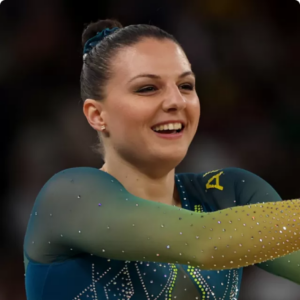
I was all-around my entire career, from 2012 through to Paris in 2024. Funnily enough, Paris is actually where that almost changed. Going in, the plan was for me to compete only vault and beam. I ended up doing all-around anyway. So even after twelve years at the highest elite level in the sport, the event line-up you walk into a competition expecting isn’t always the one you leave with.
Vault
The vaulting table sits 1.25m high for women, with a 25m runway leading into it. Gymnasts sprint the full runway, hit a springboard, and use the table for a brief hand (or hand-and-arm) support before flying into the air.
How it works:
Vault is chaos and precision happening at the same time. In about a second and a half, you go from springboard contact to hands-on-table to full flight- twisting and flipping- before landing. Start to finish, the whole skill takes maybe seven or eight seconds, and unlike every other event, it’s over almost as soon as it begins.
How it scores:
Every vault has a pre-set difficulty value (a “start value”) based on its entry, number of twists/flips, and complexity. Unlike the other three events, where difficulty builds across a whole routine, vault difficulty is locked in before you even run. Judges then deduct from that value for execution: bent legs, a hop on landing, low amplitude, and so on. Top-level vaults (a Yurchenko double pike, for example) can carry start values above 6.0.
Key terms you’ll hear:
Yurchenko (round-off entry), Tsukahara, handspring entry, DTY (double-twisting Yurchenko)- these describe the entry and rotation pattern, and commentators use them constantly, so they’re worth knowing.
What people don’t see watching it live is how much of the vault is already decided before your feet leave the ground. Your speed, exactly where you hit the board, the punch off your hands- off by a fraction and everything downstream falls apart.
Emma’s notes on vault
In the months leading up to the Olympics, I was training a Yurchenko 1½ twist: round-off onto the board, back handspring onto the table, then a twisting layout off. Even just describing it in a sentence doesn’t capture what’s actually happening: your body has to be fully committed to the twist before you’ve even finished seeing the table, because there’s no time to think your way through it mid-air.
In the end, I ‘only’ competed a full twist, which is easier to hand (half a twist less) and easy to block from the horse. If I’m being honest, gymnasts either hit it or miss it. You either trust the shape you drilled hundreds of times in practice or you bail. I was always taught to ‘bail’ on my feet; if another body part touches the ground first, it’s an immediate zero score.
Uneven Bars
Two horizontal bars set at different heights (roughly 1.6m and 2.4m), spaced so gymnasts can swing, release, and transfer between them. The bars themselves are fiberglass-cored to flex slightly, which is actually what makes big releases possible.
How it works:
Bars is rhythm and swing. In my opinion, it’s the only event that’s entirely about momentum. You’re moving between the high bar and low bar, building giant swings (full circles around the bar in a handstand position), releasing into the air and catching again, without ever really stopping. A routine has to flow as one continuous sequence- stopping or re-adjusting mid-routine costs real deductions.
Scoring basics:
Difficulty is built from a combination of release moves (letting go of the bar entirely mid-swing), transitions between the two bars, and the dismount. You also need to fulfill 5 key requirements (CR, or composition requirements), including a release element, a flight element from high to low bar and vice versa, and a specific kind of dismount.
Judges score execution separately, and they scrutinize handstands most, since a swing that finishes even a few degrees off vertical is an automatic deduction.
Key terms you’ll hear:
Tkatchev, Pak salto, Shaposhnikova- these are named release and transition skills, each named after the gymnast who first performed them, which is true across all four events but especially common on bars.
The releases look like the scary part, but the handstands are where routines are actually won or lost- every swing has to finish in a tight, controlled handstand, and judges watch that line closely.
Emma’s notes on Bars
One of the skills I’ve spent the most hours on is embarrassingly basic on paper: the kip to handstand. It’s usually one of the first “real” skills a gymnast learns on bars, but getting it genuinely correct- hollow body, straight arms, finishing in a handstand that’s actually vertical and not just close- honestly, it never stops being hard. When I came out of retirement, it took me SO long to relearn it.
Balance Beam
The beam is 5m long, 125cm high, and- this is the part that shocks people- just 10 cm (about 4 inches) wide. I like to compare it to a small iPhone. It’s padded and covered in a suede-like material for grip, but that width never changes no matter how advanced the skills get.
How it works:
A routine has to include a mix of acrobatic elements (flips and twisting series), leaps and jumps (often required to hit a specific split-angle to count at full value), turns, and a dismount, all performed in roughly 90 seconds without a fall. Composition requirements mean you can’t just stack easy skills (I wish!)- routines are built to specific requirements around skill variety.
Scoring basics:
As with bars and floor, difficulty is built cumulatively across the routine- connections between skills (linking two flips back-to-back, for example) earn a connection bonus on top of the individual skill values. Like bars, beam has its own composition requirements (full turn, split leap, acrobatic series).
A fall costs a flat deduction of a full point, regardless of what you fell out of, which is part of why beam has a reputation as the most mentally punishing event: a routine can be worth nothing extra for being difficult if it ends in a fall.
Key terms you’ll hear:
acro series, leap series, connection value, dismount- and specific skills named for the gymnasts who invented them, the same naming convention as bars.
Emma’s notes on beam
This is my event- the one I’ve built my career on (yes, I am the beam queen). World Cup gold on beam in Baku in 2019, Australian national beam champion in 2013 and 2019, and first reserve World Championships finalist on beam in 2014. Beam is the hardest event to explain to someone who’s never done it. You’re doing everything gymnastics has to offer- leaps, turns, an acrobatic series, a dismount with real height- on a piece of wood four inches wide.
The skill is real, but beam is won and lost in your head. One of the routines I’m proudest of is from the 2014 World Championships because I hit two for two- once in qualifications and once it team final, and I was SO close to making the event final for it.
Floor Exercise
A 12m x 12m sprung floor- a base layer of springs or foam under carpet, which is what allows gymnasts to tumble as high and hard as they do without the impact of a solid surface. I think it’s safe to say this is a spectator favorite.
How it works:
Routines run up to 90 seconds and combine tumbling passes (multiple flips and twists strung together at speed, usually 3-4 passes across a routine) with dance elements and choreography connecting them. That said, they can be 70 seconds, but most gymnasts prefer the full time so they can balance breathing with the dance! Unlike the men’s event, women’s floor is performed to music, which is part of why it reads as the most artistic of the four.
Scoring basics:
Difficulty comes from tumbling passes (harder passes, and passes performed later in the routine when a gymnast is more fatigued, are valued accordingly) plus required elements like leaps and turns, similar to beam. Execution deductions cover landing control on tumbling as well as dance quality and musicality.
Artistry is also a big one, where you can get penalized if you avoid dance or don’t connect with the music.
Key terms you’ll hear:
Tumbling pass, full-twisting double layout, artistry/execution score, choreography- floor is the one event where “the story” of a routine is actually part of what’s assessed, not just decorative.
Emma’s notes on floor
2018 was my strongest floor year, and it wasn’t because I’d changed anything technically- it was because I started working with a mindset coach. He taught me not to focus on the skill, but rather perform everything as though it was a single show. It took the stress out of focusing on each landing! I also worked really hard on my artistry to avoid deductions.
Why It Matters
Once you know what to watch for in each event, meets get so much more interesting- the height on a vault, the flow on bars, the size of a leap on beam, the amplitude on a tumbling pass. That’s the sport underneath the sequins and the scores.
Next time you’re watching, pick one event and watch it start to finish, no phone. I promise you’ll see something you missed before.