
How Is Gymnastics Scored? A Beginner’s Guide to D-Score, E-Score and Deductions
 Add as a trusted google source
If you grew up watching gymnastics before 2006, you probably remember the Perfect 10- Nadia, Mary Lou Retton, a flawless routine capping out at exactly 10.0. That system doesn’t exist anymore. Now, there’s an open ended system which actually makes gymnastics even more exciting!
Why the Perfect 10 Went Away
The first ten years of my gymnastics career were under the 10.0 era- each apparatus was capped at a 10, and our goal was always to get a starting score (start value) as close to ten as possible. At the end of 2005, I had to start changing my routines to the current system.
The short version: the open-ended system was introduced because the Perfect 10 had a ceiling problem. Once multiple gymnasts were routinely hitting 10.0, there was no way to reward genuinely harder routines over easier, cleaner ones. The current system fixes that by splitting the score into two separate components that get added together.
The Two Scores: D-Score and E-Score
Every routine today earns two separate scores that are added together for a final total:
D-Score (Difficulty Score)– this measures how hard the routine is. It has no upper limit. It’s built from the specific skills performed (each skill has a pre-assigned value based on its difficulty), composition requirements (CR) that must be fulfilled, and a connection bonus for certain skills performed back-to-back.
E-Score (Execution Score)– this starts at a maximum of 10.0, and judges deduct from it for how well the skills were actually performed: form breaks, bent knees, landing control, artistry (on floor and beam), and so on.
Final Score = D-Score + E-Score
So a gymnast with a D-Score of 5.8 and an E-Score of 8.9 scores 14.7 total.
This is why you’ll sometimes see a gymnast with lower difficulty but great execution score well in international competitions. It’s also a very interesting composition method coaches follow. You could have huge difficulty, but if you execute these skills poorly, you’ll be penalized, and your final score would match that of a gymnast with much less difficulty who executed it better.
For example, I was training a Yurchenko 1 ½ twist for the 2024 Olympics (5.0 D score), but my coaches ended up pushing me to ‘only’ compete the full twist (4.2 D score) because they believed the deductions I’d get for my 1 ½ twist were not worth the 0.8 tenths extra difficulty.
How D-Score Is Built
D-Score comes from three main parts, and they vary slightly by apparatus:
- Skill values — every skill in the Code of Points has an assigned difficulty value, from A (easiest) up through increasingly harder letters. Add up the values of your counted skills (usually your best 8, depending on the event) to get your base difficulty.
- Composition requirements (CR) — each event requires specific categories of skill to be present in a routine (for example, on bars: a release move, a flight element between bars, a specific type of dismount). Missing a CR costs you points off your D-score, not just a deduction. For every composition requirement you miss, it’s an immediate 0.5 deduction. That is why our coaches always stress focusing on these first, before anything else.
- Connection bonus — certain skills performed directly back-to-back (with no extra swing, step, or pause) earn bonus value on top of their individual skill values. This is most often seen on bars and beam. For example, on beam, I did two back handsprings to a layout to two feet (B+B+D), which gave me 0.4 in difficulty for the layout and 0.2 in connection bonus.
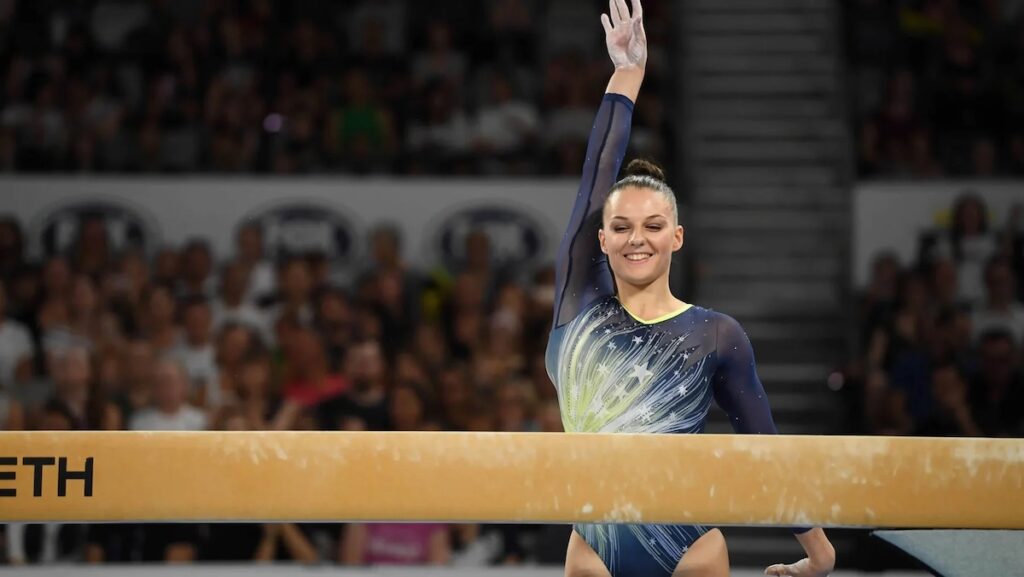
My 2024 Olympic beam routine is a great example. I included 3 of the most difficult skills in gymnastics (layout mount, layout on the beam, and a switch ring leap), which brought my difficulty value up to a 6. As an example, a 5.5 D score is considered great- you do the maths on that!
How E-Score (and Deductions) Work
E-Score starts at 10.0 and works downward. Common deductions include:
- Bent legs or arms during a skill
- Poor toe point or “flexed” feet
- Steps or hops on landing
- Falls (a large, flat deduction- usually a full point- regardless of what skill was fallen out of)
- Form breaks in general- anything that isn’t the clean, “ideal” shape a skill is supposed to have
- On beam and floor specifically: artistry deductions, like a lack of musicality or dance connection to the choreography
Deductions are categorized by severity: small, medium, large. Small deductions are 0.1, medium 0.3, and large 0.5. It may not sound like a lot, but if I make a few small errors in my beam routine, that can be an immediate 1.5 deduction from my execution score. Some examples? A small hop on a beam dismount landing is 0.1, a small shuffle back is 0.3, and a large step or run back is a whopping 0.5.
This goes back to the earlier point that coaches would prefer a gymnast doing an ‘easier’ skill well than wobbling or doing a difficult skill with poor form.
Why This System Actually Rewards Risk
Because the D-score has no ceiling, gymnasts and coaches are constantly making a real trade-off: chase a higher D-score with harder skills (which are riskier to execute cleanly and more likely to rack up E-score deductions), or keep the routine a bit easier and safer to protect execution. Neither approach is automatically “better”- it depends on the gymnast, the event, and what the field looks like at that particular competition.
Let’s go back to my Olympic beam routine. At 2024 Nationals and Oceania Championships, my beam routine had the switch ring leap (E value in difficulty, so 0.5). At the Olympics, though, the Australian coaches thought it was best for me to remove it. They didn’t think I’d get credit for it (if, in that particular skill, you don’t reach a full split with your head back, it’s downgraded). As such, I removed it, and you know what? I fell off the beam because I was so used to doing it!
Reading a Scoreboard Like a Fan
Once you know the system, a scoreboard actually tells a story. If you see a gymnast with a noticeably higher D-score than her competitors but a similar or slightly lower E-score, she’s the one taking the bigger risks. If you see someone with a modest D-score but a very high E-score, she’s likely one of the cleanest, most consistent performers in the field.
This is why it’s a fine balance- and those scoring high on both are the cream of the crop. Let’s look at Simone Biles- the greatest gymnast of all time. She had the difficulty AND the clean execution. Just check out her vault from the 2024 Olympics. Most male gymnasts find that impossible to do, let alone a female gymnast.
Next time you watch a gymnastics competition, have a look at the two separate scores- you’ll actually understand what you watched… and how the judges interpreted it.
— Emma