
The Heavier you are, the harder you fall | Ep. 2
Episode 2.


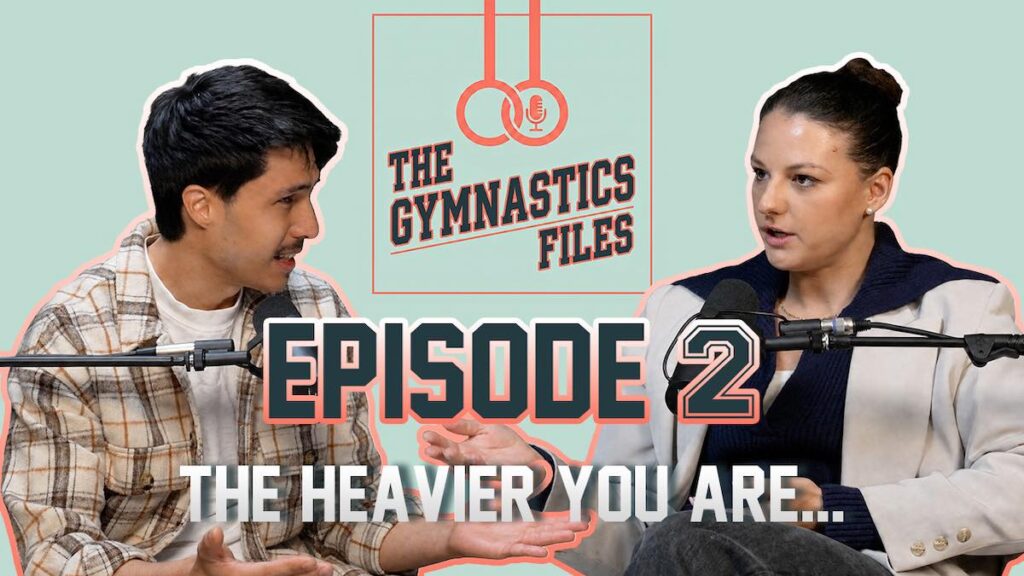
“You can’t eat dinner, you’re too fat.” That sentence should never exist in sport. It did, though- and it shaped how an entire generation of gymnasts thought about food.
We’re going back to 2010–2018, the era of Australian gymnastics where low-carb thinking got tangled up with “healthy living,” and actual performance nutrition got replaced by fear, restriction, and a lot of silence. We talk about what it was actually like to train hard while underfueled- and why most of us didn’t clock what was missing until years after we’d already retired.
Water restriction. The sweatsuit mentality. We get into how rules like that become normal, and how long they stick around in your head once you’re done competing.
Then we get into the other side of it- what changed when we started treating food like training instead of an afterthought. Carb timing, recovery, the stuff that actually protects your tendons and ligaments instead of wrecking them. And how a recipe blog and a lot of personal trial and error came out of us just getting fed up with bad advice online and figuring out what real, balanced eating actually looks like.
We also get into what a normal day of eating looks like now, what gymnasts were actually eating at the Paris Olympic Village (sustainability menus and all), and how much of a difference Team Australia’s setup made. Then we close it out with some rapid-fire hot takes on beam, scoring, and why World Champs deserves way more attention than it gets.
Watch the video below
On fueling her gymnasticsMy focus was on 'food makes you fat.' That was most of what we thought about. It wasn't 'food can help me do better.
Key Topics
Transcript (click to expand):
Read the full transcript
Arman Liew: So now I think we’re going to get into the nitty-gritty, which might be a little bit uncomfortable, but I think it’s important for our listeners to see this side. Thank goodness, I don’t think it’s prevalent anymore in gymnastics, but it was part of a time that you were very much in the midst of. Let’s call it the 2010 to 2018 era, which saw Australian gymnastics have some of its most successful years, but also probably some of its most unsuccessful years. I don’t mean that in a negative way. I think there are a lot of things that could have happened to it, and it’s not per se the gymnast that caused it. It was external factors, whether that be changing coaches or a different environment that you were training in. I guess from the outside looking in, I would assume that before every routine you’d be loading up on carbs. I mean, if you ask my partner, I can’t even take my dog for a walk in the morning unless I’ve had a banana or something like that. And it’s like 500 meters, the whole walk. So you’re doing these intense routines on floor, beam, vault, bars, but from what I’ve seen in the media and some articles, you were actually on a pretty low-carb diet while doing all of that. How does that work?
Emma Nedov: I don’t know, but we made it work. Whether that is correct or not, I don’t know. But it had been done a certain way for such a long time and never really been challenged. I think with better science and understanding now, we can correlate your fueling and your performance, and even injury. Not enough protein, for example, and you’re more prone to stress fractures, those types of things. I just don’t know that there was that level of education and true understanding. From an athlete’s perspective, with all respect, we sat through nutrition seminars and we were given the opportunity to learn. But at that age, it’s in one ear, out the other.
Arman Liew: For sure. And actually, when you said that, I think it’s easy to say it wasn’t even gymnastics specific. If we think back to that time, Weight Watchers and all these other diet plans, I feel like as a society we’ve become more in tune with nutrition over the last few years. So I kind of take back what I said about making it sound gymnastics specific, because it could have been for any individual. The Atkins diet, for example, was very, very prevalent then. And it wasn’t so much “this is a weight loss diet” as “this is healthy, this is how you’re going to function better,” right?
Emma Nedov: Yeah, it was like wellbeing. But to bring it back to gymnastics, you are in some way correct, because that was how it was understood. That was how it was understood, and like I said, it had been done a certain way for so long. The facts genuinely are, when I was going through a puberty phase, 15 years old, it was like, “Oh, you can’t eat dinner, you’re too fat.”
Arman Liew: Wow.
Emma Nedov: And that was my personal coach at the time. That was her level of understanding of nutrition. And I think where I had to really understand it was that she meant it from a place of, “I don’t want you to get injured because you’re heavier.”
Arman Liew: Okay, so that was the mentality behind it.
Emma Nedov: At least from my experience, yes. You’re getting heavier, therefore you’re at more risk of injury. Now, if we look at gymnastics, it’s something like 15 times your body weight that comes down on your ankles when you’re landing a tumbling line. So I can kind of understand where her brain’s going. But her understanding, from her experience as a gymnast, was that to be lighter, you don’t eat food. You don’t eat water. Sorry, you don’t drink water.
Arman Liew: Wait, so even water was limited?
Emma Nedov: Yeah. So it wasn’t limited to just carbs, or to just one or two things. Maybe the people that had more of an education around nutrition and food would talk in macronutrients, but otherwise, from my perspective, I got told by someone else that they were told to just drink the water, or not drink it: put it in their mouth, swish it around so they get rid of the dry mouth sensation, and then spit it out so they’re not too heavy.
Arman Liew: I’m just trying to wrap my mind around it. I feel like the physiological reaction would be, “No, I’m going to drink that water. I’m going to taste a bit of sugar in the middle of all of this to give me some energy.” But then if we look at the other side of the coin, you guys were hitting these routines. You weren’t passing out in the middle of the beam or something like that. And I don’t think it was limited to yourself or your team. I wouldn’t be surprised if other countries were doing the exact same thing. Looking back on it now, do you feel you noticed much of a difference? Did nutrition actually play much of a part, or was it more, “My coach told me this, I sort of believed it, or I felt like that was the case, and I just went and did it”? Were you able to block out hunger signals, or thirst, for example?
Emma Nedov: Yeah, I don’t really know. I don’t think I questioned it. If I’m honest, one thing I definitely noticed was post-puberty, when I got older. Now, I have to put a little bit of accountability on me, or I would say almost all accountability on me, because I didn’t take nutrition very seriously. I had just learned how to operate, as you said, I guess one could argue underfueled. But it was just a matter of fact that I never considered it. I don’t think we looked at nutrition as a way to enhance performance. We looked at it as something that could hinder performance. So we were looking at nutrition from a really negative perspective rather than using it to our advantage. Then I remember going to the 2018 World Championships. I was 22, so I’m a lot older, well and truly past the puberty phase, where the science definitely points towards, in the lead-up to puberty, you have a lot more energy that doesn’t necessarily need to come from food. Then you get older and it’s like, “Oh, you need to supply your body with energy now.” So I was at World Championships with a Red Bull in my drink bottle.
Arman Liew: Was that contraband?
Emma Nedov: Yes. I was not allowed. Way too much sugar, fizzy drink, no way. But I felt so drained. Now, it wasn’t just from nutrition; we’d also overtrained. I remember doing a few interviews about training a huge number of days in a row, like 18 or 20 days in a row, at that World Championships.
Arman Liew: In a row, wow. And that’s not like before a competition. With any sport, you taper. If you think of a marathon runner and their schedule, it’s quite intense in bursts, but especially in the lead-up to the race, it’s bare bones. But for you, 18 days in a row. And is this full routines?
Emma Nedov: Yeah, that was the worst. That was the worst experience. However, like I said, the nutrition part of that was that I did not understand that nutrition could enhance performance, or be something to really support and fuel you. I think we looked at food and nutrition as replenishment or recovery, not so much as fueling for performance. So it wasn’t until I retired and started studying nutrition through Simpler Health that I learned, “Oh, I can actually use nutrition as a way to enhance my performance and help me with my gymnastics.” And I think it wasn’t due to neglect. I don’t really know what it is, right? Everyone has their own experience of how their coaches and their organizations dealt with fueling. But I would definitely say that when I wasn’t at home eating my mum’s home-cooked meals and I was left to my own devices, I just didn’t really care enough about food. My focus was on “food makes you fat.” That was most of what we thought about. It wasn’t “food can help me do better.”
Arman Liew: Which is so interesting. Let’s actually use you as a real-life example. Part of that era, 2018, 2019, and then ultimately the second Olympics that you tried for, it’s fair to say you had the same sort of mindset nutritionally leading up to the 2020 Olympic trials?
Emma Nedov: Yeah, I didn’t understand how it could help me. I started to learn that, obviously, you want to be eating well. I started focusing on eating healthier than I probably had when I was in my teens, when I went to a fun competition in Portugal and we snuck out. You weren’t allowed lollies. At one point they would go through our suitcases to make sure we didn’t have any junk food in there. Anyway, that’s another whole story. So we snuck off to the shops and I bought a container of sour straps. Like what you’d have in a canteen, where you’d buy one or two sour straps for 30 cents. We had a whole container.
Arman Liew: Wait, this is in Portugal?
Emma Nedov: Portugal. I was 14. And we had that in our room, eating the sour straps. Delicious, right? We were so cheeky because we weren’t allowed it. We’d sneak down to the shop and get lollies, because we weren’t allowed. It was crazy. So at that time I didn’t care. It was just, “Oh, we’re not allowed, so we’re going to go get it.” And it’s yummy, right? It was eat when I’m hungry, eat because I have to, eat what I’m being told to, or eat sneakily. So then when you get older, you’re like, “Okay, I’m starting to notice that when I eat, I get more energy,” or “I’m starting to notice that when I’m hungry, I should make healthier choices about what I eat, because I’m an elite athlete.” So I would say that as I got older, my eating choices improved. I still loved a good Chicken Crimpy as a snack.
Arman Liew: Always. Delicious.
Emma Nedov: However, it wasn’t until I really understood the power of food and what it can do for you that I transitioned into making it a part of my training.
Arman Liew: And I guess if we correlate that to 2023, 2024, those nine months you were training for the Olympics, your nutrition would have been completely different to even three years before that, so let’s say 2020.
Emma Nedov: Oh, yes, big time. And to bring it back to the carbs, I finally had an understanding of how almost like carb cycling worked.
Arman Liew: Carb cycling. Wow, okay.
Emma Nedov: Yeah, carb cycling, carb timing around your training. These are intricate details of nutrition and fueling that would never really be covered to the same extent when you’re younger. In gymnastics, for example, we’re elite high-performance athletes at the age of 13. And if you try to tell a 13-year-old, “Hey, you should cycle your carbs around your training…”
Arman Liew: “What’s a carb?”
Emma Nedov: Right? You’ve got to start from scratch. So I focused not just on what I ate, but also on timing, and on how I could use food to help with my rest and recovery. I also tried to avoid what I found were inflammatory foods for me. I was recovering from an Achilles rupture from years and years prior, but because I’d had years off, I knew it would flare up again.
Arman Liew: Is that what usually happens with an Achilles injury? You have to be wary of it re-rupturing, maybe? I’m not sure about the mechanics behind it.
Emma Nedov: I mean, it could have all been in my head, but my Achilles is a lot thicker, it feels different. It’s been sewn together.
Arman Liew: So it’s not the same as a natural one. Yeah, of course.
Emma Nedov: It’s been sewn. So it was more about being really conscious of how I could support my tendons and ligaments. I went down this pathway of working with my chiropractor and my nutrition team, and making sure that, for example, I avoided alcohol. For the nine months that I was training for the Olympics, I didn’t drink anything, whereas I love a good wine. And that wasn’t hard for me, because I understood why I was doing it. I was doing it for my body, so that I could rest and recover and train the best way I possibly could. I also just avoided things that I noticed would be a bit inflammatory to me. I’ve always been a little bit dairy intolerant, so I thought, “Well, I’ll just remove it for the time being.” That’s stuck with me, hence my dash of soy. They were just little things that I focused on. But like I said, the key mindset shift was that it was fueling for performance. How can I enhance my training? How can I make sure my body is protected and working like a machine? Whereas in the past, it was more about what we could eliminate, what we could remove, what we could make sure wasn’t going to have a negative impact. Food was perhaps looked at in a negative light. The shift more recently has been to look at food in a really positive way. However, I think we’re now maybe sitting on the cusp of “how do we really manage that? What do we actually do?” Because, as you would know, it’s quite individual.
Arman Liew: Oh, absolutely, it is individual. And I think it goes back to that societal mindset, right? We’re talking about how gymnasts are now changing their mindset to “how can we enhance our performance?” But on a global scale, people are trying really, really hard to remove diet culture. So gymnasts themselves are making healthy choices, but are they now going to get judged for that? “Oh, you’re eating like a bird,” or “you’re only eating healthy foods.” What I find interesting when I see competitions is that some of the boys are eating lollies and the girls are having a Gatorade or some chocolate in between apparatus. I think that has changed. If you watched the 2016 Olympics, I don’t think I would have seen an athlete eating anything, or, God forbid, drinking something, right?
Emma Nedov: Yeah, I never ate during training. I never ate during training, never ate during comps. I remember some coaches would walk around with glucose jelly beans and give their athletes the glucose jelly beans. I just didn’t really do it. I don’t think I really thought about it, if I’m really honest. For some people it took up a lot of head space. It wasn’t until I quit gymnastics that I realized the impact that food, my body weight, and my image had on me. When I was in gymnastics, I didn’t really think about it, except for that one year when I was going through puberty and my coach was buying me a sweatsuit from China.
Arman Liew: She bought you a sweatsuit from China?
Emma Nedov: Yeah, she got her daughter to buy me this sweatsuit. It’s literally plastic, black pants and a jacket. You zip it up together and go running in it.
Arman Liew: And it’s meant to make you sweat?
Emma Nedov: Yeah, and then you get skinny.
Arman Liew: Gosh. I mean, to really hone in on being as light as possible… I can think of a handful of other sports that do similar things. A jockey going to a sauna, or weightlifters. It’s not so gymnastics specific, but when you say it out loud, it’s like, “Oh wow, that’s what was done.”
Emma Nedov: Well, it’s just a bit crazy, and you’re right. I remember being at the 2011 Youth Commonwealth Games, and in the hallway at five o’clock in the morning I hear this super annoying skipping sound. I’m like, “What is that?” I opened the door and looked through the little peephole, and there were the boys outside, skipping, skipping, skipping, because they had to make weight. The thing is, in gymnastics, we ask so much of our bodies. Yes, there’s the 15 times your body weight landing when you’re doing a tumble. But there also has to be the strength, the endurance, and the ability to even get in the air and do three somersaults, for goodness’ sake. So by focusing only on the weight perspective, on being as light as possible, you’re only focusing on one area of performance. If you focus on the whole of nutrition, then you’re asking, “All right, how do we make sure we can fuel the athlete to tumble, to land, to swing, and then to do that for six hours?” So it’s more about how we can actually do the whole entire thing. That’s what’s maybe been missing.
Arman Liew: For sure. And I think it’s going to be really interesting to speak with some of our future guests about their diet and their nutrition plan, because it’s universal to any sport. You hear about it all the time: nutrition is so important for recovery, for limiting injury, all that sort of stuff. So it’s really good to get that insight and to hear how it differed for you and what you were able to do.
Emma Nedov: Yeah, absolutely. Look, I’m sort of grateful for it because I learned so much about it. Number one, it’s something every single human being deals with, as we’ll touch on in a second with you. And secondly, it’s something we can use to our advantage, and it should simply be another part of being an elite athlete. You’re a human, you’ve got to eat anyway. But when you’re an elite athlete doing anything, let alone gymnastics, you’re not eating like the regular person. I always put it this way: you’re not like a Mazda needing regular E10, like my little Mazda. We’re like little Lamborghinis.
Arman Liew: Yeah, absolutely. Or Bentleys.
Emma Nedov: It’s like a Bentley. I would put my little E10 in my Bentley. So that’s the area of expertise we’re trying to strive for, and it’s really difficult to get that out of a 13- or 14-year-old kid. One thing I’ve learned is that when I talk to younger athletes about how I focus on nutrition now, how I focused on it in the lead-up to the Olympics, and my neglect of it in the past, it helps them understand a little more that they don’t have to be perfect, but that it can actually help them. And that’s all you ever want to do, right? You want to ask, “How can we help you? How can we provide you with more support?” That kind of sounds along the lines of what you started doing. You went down this health journey, and that’s how you’ve now created this incredibly successful food blog, right?
Arman Liew: Yeah, well, I sort of took all that. If we roll it back to when I did gymnastics in the younger years, my sister and I both did it, and we had very different dietary suggestions from the coach, I should say. But when I stopped, I was in my teens and wasn’t active anymore, wasn’t doing any of that sort of stuff. So I kind of went the other way. I put on a lot of weight and didn’t do anything, because it was my only sport that I did consistently at that time. Then when I started learning about nutrition a little more at university, it was very much “you bulk up, you’ll get muscle following a low-carb sort of diet,” which I think is very incorrect. But that was what was popular at the time, so I followed that mentality: “Okay, to bulk up I need to do this,” with no other knowledge.
Emma Nedov: Was that because of bodybuilding and stuff? You obviously have to moderate your carbs.
Arman Liew: Yeah. At that time, those forums like bodybuilding.com were huge. Not a social network exactly, but you’d go on there, read what people were eating, and think, “All right, I want to emulate them to look really big and bulky.” I was in my early 20s and I’m like, “I want to look like that.”
Emma Nedov: Meanwhile, everyone’s on steroids and peptides.
Arman Liew: Literally. And me, oblivious to this, going on a low-carb diet, and I go the other way. I lost all this weight. I went from a potato to a French fry, it was crazy. I was thinking, “Oh, this is how you do it,” and then, “Why are my muscles showing? Why is it just my bones?” So that’s when I started The Big Man’s World, in my final year of uni, as a log for myself. I was like, “Okay, I’m not going to follow what these bodybuilders are saying online. I’ll write my own program and really learn about nutrition.” So I took everything I could online and did a minor at university in it so I could really, really understand it. From that, I started keeping a log of the things I was making that had all the correct macros. If I did a weight session, I needed to eat this much protein, and so on. I went through a phase where I didn’t want to drink a protein shake, so I’d make a cake and have the cake after it. I would write those recipes down, and over time I realized I had a bit of an audience who were reading my diary. It kind of felt like that, because it was just a website on the internet that anyone could search. That’s when I thought, “I kind of like doing this recipe development and testing things out.” I started creating more stuff to enhance my workouts at the gym. I didn’t want the typical porridge for breakfast, so what could I make that was a bit more interesting? I enjoyed that creativity, making something really high-protein in a less conventional way. Over time I kept posting and built a bit of an audience online, and I thought, “You know what? I’m going to see if I can make this into a bit of a job.” I had some friends in America who were what you’d call, at that time, full-time bloggers, and I thought, “I want to do that: develop these recipes, create them, share them online, have people make them.” So over time that’s what I did, and I was able to grow this business into what it is now, which is healthy, everyday recipes that I would make to fuel my performance, or that just taste good, with a little bit of everything. Not just strictly healthy recipes, but some indulgence as well, because that’s part of life, right? You have a balance for everything.
Emma Nedov: Did you end up getting real bulky?
Arman Liew: So this goes back to a conversation we were having before, which is that we’re very similar in that we need someone to tell us what to do. It was effective when I had a personal trainer. Shout out to Mitch. When he moved to Croydon, which is in the eastern suburbs of Melbourne, a bit of a drive from where I was, it was hard to commit to a one-hour, 10-minute commute to see him. All the gains I’d made just slowly slipped away. Then I go into phases of “All right, I’m going to try again,” stick to nutrition really well for three, four, five weeks, and then just get sick of it. Not that you have to, but in my case I had to eat more than I needed to, and I really got sick of food in a way. I had no variety or anything like that.
Emma Nedov: Now, I remember hearing once, and I don’t know how true this is, but this is what I got told: that Ian Thorpe had to eat something like above 7,000 calories a day.
Arman Liew: It would not surprise me. He’s such a tall, muscular guy that, just to keep the machine moving, you would need that. But to think you’d have to eat 7,000 calories a day… I’d be like, “You know what? I would be happy to stay a stick figure than look big and bulky if I have to do that.”
Emma Nedov: Yeah, genuinely. It’s quite funny. I had this thought while we were talking: you should make little pre-training snacks and we can give them to the guests. “Try this, see which one’s your favorite.” No, no, no, it’s me giving you work.
Arman Liew: No, but that is funny, that’s what I would do. A lot of the stuff on the website, I would have one of the energy bars before I’d go and do a workout. In today’s world, everything is “oh, this is processed, that is processed.” I feel like the water you drink is probably processed. Who knows, right?
Emma Nedov: We’re back to drinking raw milk, don’t you know?
Arman Liew: Which I felt like was illegal a few years ago. I’m not an elite athlete in any regard, but to do the things I want to do every day, or to build something, nutrition is just such an important part. So it’s really interesting to correlate that to your gymnastics and everything you did. I just think, God, if I had to do that, and eat a certain other way, the way maybe you were eating at that time, I probably would just leave the competitions. I’d go present, then walk off and be like, “You know what? I’m happy to get a zero.”
Emma Nedov: Well, there’s more to life than food. But one thing that gets highlighted is that gymnastics can sometimes be somewhat unrelatable to the average person. It’s cool to watch, and maybe you tried to do cartwheels on the school oval once upon a time. However, there are all these fundamental bits and pieces that create relatability, and that’s a lot of what we’re trying to do here with the podcast: highlight those relatable bits and pieces. One thing that connected our stories as well was that when I left gymnastics, I had to navigate what nutrition and food, and that relationship to self, look like when I’m not training 20 hours a week. It is very different, but it’s also a fundamental part of life. I talk about nutrition as fueling for performance as an elite gymnast, and there’s a certain way to do that. Then I almost had to reframe my mindset: what is it that I do now? How do I fuel myself to sit down and chat to you for an hour? That’s totally different to fueling myself to train three hours of five-beam routines.
Arman Liew: Yeah, that’s an interesting way to look at it. Has it actually changed for you much from when you were training for the Olympics to today? Let’s do something I always see on YouTube, Instagram, and TikTok. I looked at some of the statistics, and you can see what people search for, and one of the most popular questions is “What does this person eat in a full day?” What does a day on your plate look like? So if we use you now, what does a day on Emma’s plate look like?
Emma Nedov: Oh my god, no day’s the same.
Arman Liew: No day’s the same.
Emma Nedov: I just moved to Carlton with Julian, so we’ve been out a lot. However, standard: most of the time I’ll eat breakfast at home. It’s usually always eggs. If my beautiful fiancé is going to make me breakfast, he usually makes an omelet. He loves making omelets. And if it’s just me, I do scrambled eggs. Not just one. I usually have two or three eggs, because I learned that there’s only about seven grams of protein in one egg.
Arman Liew: Yeah, I feel like that was drilled into me as well. Three eggs or nothing.
Emma Nedov: Right. And we don’t keep a lot of food in the house. If we have sourdough, I’ll have it on sourdough. If we have fruit, I’ll have fruit. So for the past week, it’s looked like an omelet with three eggs and either a pear or sourdough. And a coffee, obviously.
Arman Liew: Being in Melbourne, I feel like if you don’t have a coffee, why are you here?
Emma Nedov: Weirdo. Actually, I went through my matcha phase.
Arman Liew: I feel like matcha is slowly taking over as the new coffee. So popular.
Emma Nedov: Anyway. Back to the gymnastics stuff. Pre-gymnastics, it would have been, without a doubt, two pieces of toast, probably four eggs. I think I was having four eggs when I was training. And I would definitely also have fruit. So I’d say the only difference is that my carb needs are likely lower. However, it doesn’t mean my carb desires are lower, or my protein desires. My overall appetite is similar, I would say. Did you ever find this: the more I trained, the less hungry I was?
Arman Liew: I feel like on the days I do more exercise, I’m less hungry, which I found was such a bizarre concept. I thought it would make me hungrier so I could eat and not think about it. And then it gets to 11 p.m. and I’m like, “I just need to have another bowl of cereal.” I’m like, why am I doing this?
Emma Nedov: Yeah. So there are those small things. Lunch is usually meat and veg of some sort. Maybe sometimes a wrap, maybe sometimes a salad. I was so mature on Saturday night. I was going to a gymnastics center the following day, and as I said to you, I was driving three hours there because it was in Gippsland. So on Saturday night I didn’t go out, didn’t do anything, and I made chicken casserole.
Arman Liew: Beautiful. How good.
Emma Nedov: So that was my lunch yesterday: chicken casserole. And I think I had another pear.
Arman Liew: Nice, getting through the pears.
Emma Nedov: You really like pears. [inaudible] And then dinner. What did I do for dinner last night? Oh, I went out.
Arman Liew: And I guess for our listeners that don’t know, Lygon Street is probably one of the big foodie suburbs, I guess, in Melbourne. You’ve got a big Italian congregation of restaurants. There’s so much choice, and they’re all pretty good. So it makes sense that you move there and four nights a week you’re eating dinner out.
Emma Nedov: Yes, that’s definitely us at the moment, which is crazy. I don’t think that will last. I think it’s still the novelty, right? But we went to the restaurant that has the Olympic cyclist. The Olympic cyclist used to… I don’t know. Anyway, we just had some arancini balls and [inaudible], and the arancini ball was literally the size of my head, so we had one each. And I had a glass of red wine. So if I compare it to gymnastics, no way. I’d be a lot more conscious of “is this enough food? Is this enough carbs?” Most of my focus was on whether this was going to help me perform better tomorrow. Now I don’t really care about that, because what I ate yesterday is fine for me to feel very comfortable sitting here chatting to you. But I probably would have been a bit more diligent when I was doing gymnastics, which is the main difference.
Arman Liew: Yeah. And a lot of the travel you did, you did a lot of competitions overseas. I think one of the best parts of traveling is trying all the cuisine in different places. Did you do that?
Emma Nedov: No, we didn’t.
Arman Liew: Oh, no. I think I would struggle with that. I’d be like, “But I’m in Spain, I want to have a paella,” or Italy…
Emma Nedov: It’s tricky, because a lot of the time when you’re traveling for sport, you want to keep as much of a routine as you can.
Arman Liew: That’s what I was about to say. So even if we go to Paris, and you were in the athletes’ village, how was the food there? I saw some stuff that came out of it. They apparently had these chocolate muffins that everyone went crazy over. How was the food in the Paris Olympic village?
Emma Nedov: Oh my god, so good. Well, wait, let me rephrase. The bakeries, the boulangeries that were in the village, which are free, might I add, were amazing. I personally didn’t love the muffin. It was a bit much for me. But they had cookies, and I’m more of a cookie queen, and the cookie was delicious.
Arman Liew: So the athletes’ village wasn’t just a giant food hall, like a cafeteria. They actually had little bakeries around.
Emma Nedov: Yeah. You walk through the village. This is funny, just a random extra, and maybe we could even ask some of our Olympic friends what their take on the village was. It’s like going through a little town. You’re walking through streets of countries, because every country has its own building, and the countries usually deck out their building in some way. They’ll have some flags up. The Australian buildings were all yellow and green. The global food hall was, to begin with, majority vegan.
Arman Liew: Which is very odd to hear, that France had a vegan food hall.
Emma Nedov: Yeah, I think it was for sustainability reasons. But that didn’t last long, because A, they ran out of food, and B, I think they did have some meat options, but they would just run out of them because they were obviously trying to have less meat. The athletes were not impressed with that.
Arman Liew: So what would you do in that situation? Uber some steaks or sausages?
Emma Nedov: Well, Australia’s got you covered, because in the Australian buildings we had a mini Woolworths.
Arman Liew: Woolworths, as in the supermarket?
Emma Nedov: Yeah, yeah. And they made us poke bowls for lunch every day. For breakfast there were boiled eggs, avocado, toast, cereal, Vegemite, all of that.
Arman Liew: Great.
Emma Nedov: It was so good. Actually, after the first two days, I didn’t end up going to the food hall. I just stayed in the Australian building. And in the mini Woolworths, you know those little tuna bowls where they have tuna and rice and stuff? That ended up being my dinner a lot of the time, because in gymnastics we were in a late subdivision, so we would finish competing or training at, like, midnight sometimes. We’d come back to our mini free Woolworths and eat those. I mean, we had two or three each. Amazing tuna bowls.
Arman Liew: And 24 hours as well.
Emma Nedov: Yeah, because we were staying there. If you wanted a little midnight snack, you’d pop downstairs.
Arman Liew: So good. And I guess the big question for all you Aussie athletes: was there a coffee van? I feel like that’s super important, probably more important than the food, to make sure you’re getting your good coffee every day.
Emma Nedov: Oh, so good.
Arman Liew: That’s such a good insight. From the outsider looking in, you’d assume there’s just one giant food hall that you go into at a designated time, with a salad bar, your hot food, and that sort of stuff. But you wouldn’t even need to leave the Australian contingent.
Emma Nedov: Yeah, not every country had what we did.
Arman Liew: Not every country had what we did.
Emma Nedov: So you would typically go to the food hall. We did a really great job. We had nutritionists and dietitians in the Olympic team for Australia, which again comes back to how I think we’re really understanding, in elite gymnastics as well, the importance of nutrition, what you do, and how you can use it to your benefit in a positive way. We definitely saw that at the Olympics, and it made me very proud to be an Australian, and very grateful, because I didn’t have to go to the vegan food hall. It’s also chaos there, because there are so many athletes. It’s a little bit overwhelming. So it was pretty cool to be able to stay and do that here. I spent a lot of time with the other Aussie athletes, but everyone eats differently too.
Arman Liew: You’d see the basketball players with, like, 10 plates of food.
Emma Nedov: Yeah. Imagine sitting next to Ian Thorpe, who’s trying to eat 7,000 calories, and I’m there like, “Whoa.” Anyway, that didn’t happen. I know. Just an example. But like I said, it’s something everyone goes through, whether you’re in elite gymnastics or not, and it’s something we can use to our advantage as elite gymnasts. The earlier you learn that, the earlier you’ll reap the rewards.
Arman Liew: Yeah, absolutely. All right, as we wrap up our conversation today, I thought we’d do some gymnastics hot takes. I’m going to ask you a few questions to get your perspective, because I feel like in the gymnastics world there’s going to be a different opinion on all of this. We’ll start with one I feel is quite universal, but I could be wrong: is beam the hardest apparatus?
Emma Nedov: Oh, it depends on the context. I would say beam is the hardest apparatus in women’s gymnastics to compete.
Arman Liew: To compete.
Emma Nedov: To compete, yeah. That’s at least my theory. On floor, vault, and bars, you don’t have a long time to consider that you’re doing a routine. Once you start, you’re going. On beam, you’re in this state of awareness the whole time you’re doing your routine, so you can get more nervous the further through the routine you get. Whereas on bars, you don’t have time; vault is over in two seconds; and on floor, you’re so puffed out that you have no time to consider what’s actually going on. On beam, you’re just so aware of what’s happening that it’s really scary to compete. To train, it’s just scary, and it’s stupid. What do you think, from your perspective?
Arman Liew: Well, for women’s gymnastics, I would say beam. In men’s gymnastics, controversial, but I thought rings.
Emma Nedov: I’ve been told pommel.
Arman Liew: Yeah, I think a lot of people think it’s pommel, but I feel like it’s very hard to get a really good rings worker.
Emma Nedov: Yeah. But high bar, I feel like high bar would be so scary. It’s so skinny.
Arman Liew: Yeah, it is skinny, but then you’re doing the releases and stuff, so that’s not for me.
Emma Nedov: Oh, I’m actually a real chicken.
Arman Liew: Really? You definitely can’t tell from the outside, from the skills you’re throwing.
Emma Nedov: No, I’m actually such a chicken. All of the skills that I do, I train very, very well for. I was not an athlete that just chucked skills.
Arman Liew: You see some of these athletes on Instagram going, “I’m just going to practice a triple layout or something,” and you’re like, “Okay, for what?” “No, just for fun.” Well, you have fun with that, then. Interesting. All right, this next one I think the everyday person might not understand: the best gymnast doesn’t necessarily win. True or false?
Emma Nedov: The best gymnast doesn’t necessarily win. I guess it depends on what the best gymnast is. What’s the definition of the best gymnast? I’m going to be so philosophical about this for one second. If you say the best gymnast is the gymnast that does gymnastics the best, then you would expect that they would win, because doing gymnastics the best, I would interpret as not only training really well and doing the hardest skills with the most attention to detail, but also nailing it in competition. Gymnastics has those layers. You want to be able to learn skills as easily as humanly possible, then train them as well as you can, and then competing is a whole other ball game. When the time crunch comes, you want to be able to nail your routine and your skills. So I’m going to say true.
Arman Liew: True. Okay.
Emma Nedov: You?
Arman Liew: Oh, see, I’m on that line of true or false. The only reason I’d say that is that you could have nailed all your beam routines leading up to a competition. You nail qualifications, you nail team finals, you nail the all-around. Then come event finals, something happens. You don’t have a good warm-up, or you slip on a skill you’d always nail, and you fall off, and that takes you completely out of the medals. It could be one little thing on the day. Results in the past have shown that the favorite for beam, or the favorite for pommel, doesn’t actually end up winning because of a little error. If you look at everyone’s historical results leading up to it, they might have had the highest score to date on that apparatus, but on the day of competition… which I sometimes find so fascinating about watching gymnastics, because you just don’t know. You have a gut feeling of who you think might win, but it just takes one little mistake and you don’t get the medal.
Emma Nedov: And you’ve just highlighted why gymnastics is obviously the hardest sport in the whole entire world.
Arman Liew: Yeah, absolutely. It comes down to it. That’s interesting, and it’ll be interesting to ask some of our future guests that as well, because they might say, “Nah, the best of the best wins,” or not. This next one will be interesting to get your take on: gymnastics scoring is too complicated for casual fans.
Emma Nedov: Ooh. I mean, sometimes even I don’t understand it. Is it too complicated? I’m going to give a roundabout answer. I feel like it does a really good job of giving an athlete and their coach feedback on their routine. The score should reflect the routine they’ve just done. But perhaps to the casual fan, there’s no explanation behind why the score came out the way it did. So maybe that’s why it’s hard. I think I kind of agree that it is a little bit hard, because it hasn’t been articulated.
Arman Liew: No, it hasn’t. And I think once they got rid of the perfect 10, it became really difficult for people to understand. But I also think a significant population of people who watch gymnastics still think there’s a perfect 10, so when they see a 13.5, they think, “Oh wow, did they do something absolutely insane and get all these extra points?” And I think it’ll be interesting if commentators, or even us on this, can really… actually, this is a plug for our website, which is going to have a lot of this information. We’re going to break down what a D score and an E score are in easy terms that the everyday person can understand. So yeah, I agree with you on that one. Okay, one more quick hot take: do you think the Olympics gets too much attention compared with World Championships?
Emma Nedov: Yeah, totally. But I mean, the Olympics gets the attention because it’s the Olympics. I was always brought up with the understanding, through the national team, that World Championships is actually a harder competition. If you win a World Championships, particularly not the year after the Olympics, because most of the Olympic athletes are resting that year…
Arman Liew: It’s interesting, right? The first World Championships after an Olympics, I feel like it’s anyone’s game to win a medal.
Emma Nedov: Oh yeah, that’s the best time for an up-and-comer to just hop out at World Championships. But I’d say this year and next year, we’re in 2026, are the biggest World Championships to really tell you who the best gymnast is, to go back to a previous question. But then the Olympics has that prestige because it’s every four years. From a competitor’s perspective, World Championships is without a doubt one of the best competitions you want to go into and win. Winning the World Championships holds a different level of value to winning the Olympics.
Arman Liew: But that goes back to what is shown on TV, right? You see all the sports during the Olympics, but if we go to World Championships, I feel like people are scrounging around to see where they can watch it.
Emma Nedov: Well, we’re going to fix that.
Arman Liew: We are absolutely going to fix that. Look, that was something fun for us to end the conversation with. I feel like we could stay here and talk all day, but I think we should wrap up our first episode. Thank you so much for listening. Be sure to check us out on Instagram, The Gymnastics Files, and our website. We’ve got a lot of exciting guests to come. What we said at the start is that we want to use this as a platform to ultimately give back to gymnasts. We mentioned it there, but we’ve got the athlete fund. If we break it down to really simple terms, for every dollar we generate on here, a percentage is going to go to an elite athlete. So I’m excited for what’s to come, and there’s a very exciting guest next week.
Emma Nedov: Yes. Oh my gosh, I’m so looking forward to it, because I feel like we will have this unique insight into things, which should be really fun. I’m just really excited by this. It’s something I would have loved when I was younger, to really connect audiences. Our sport really deserves it. Gymnastics is so awesome, so let’s highlight that.
Arman Liew: Hopefully this will be able to do that. So stay tuned, subscribe, and all that sort of stuff. We’ll probably have to work out a better outro for the future, when we know what we’re doing properly. But thanks for listening, and we’ll see you on the next episode.
Emma Nedov: Sounds good. Thanks, guys.